
From the Deep End · ATU Articles & Commentary
Water Is the Classroom: Speech-Language Therapy in the Pool
In the pool, a speech-language pathologist still treats communication and swallowing. The water changes the conditions, not the job. Here is what the water does, what safety takes, and what the research shows so far.
Published October 23, 2026Water is not the treatment. Water is the classroom.
That line sums up how we think about speech-language pathologists in the pool. As SLPs begin to offer pool-based services, a fair question follows: what does aquatic therapy training have to do with speech-language pathology?
Quite a lot, it turns out. Not because the water treats anything on its own, but because it changes the conditions under which communication and swallowing are practiced. And an SLP who brings a patient into the water has to understand those conditions to keep the patient safe.
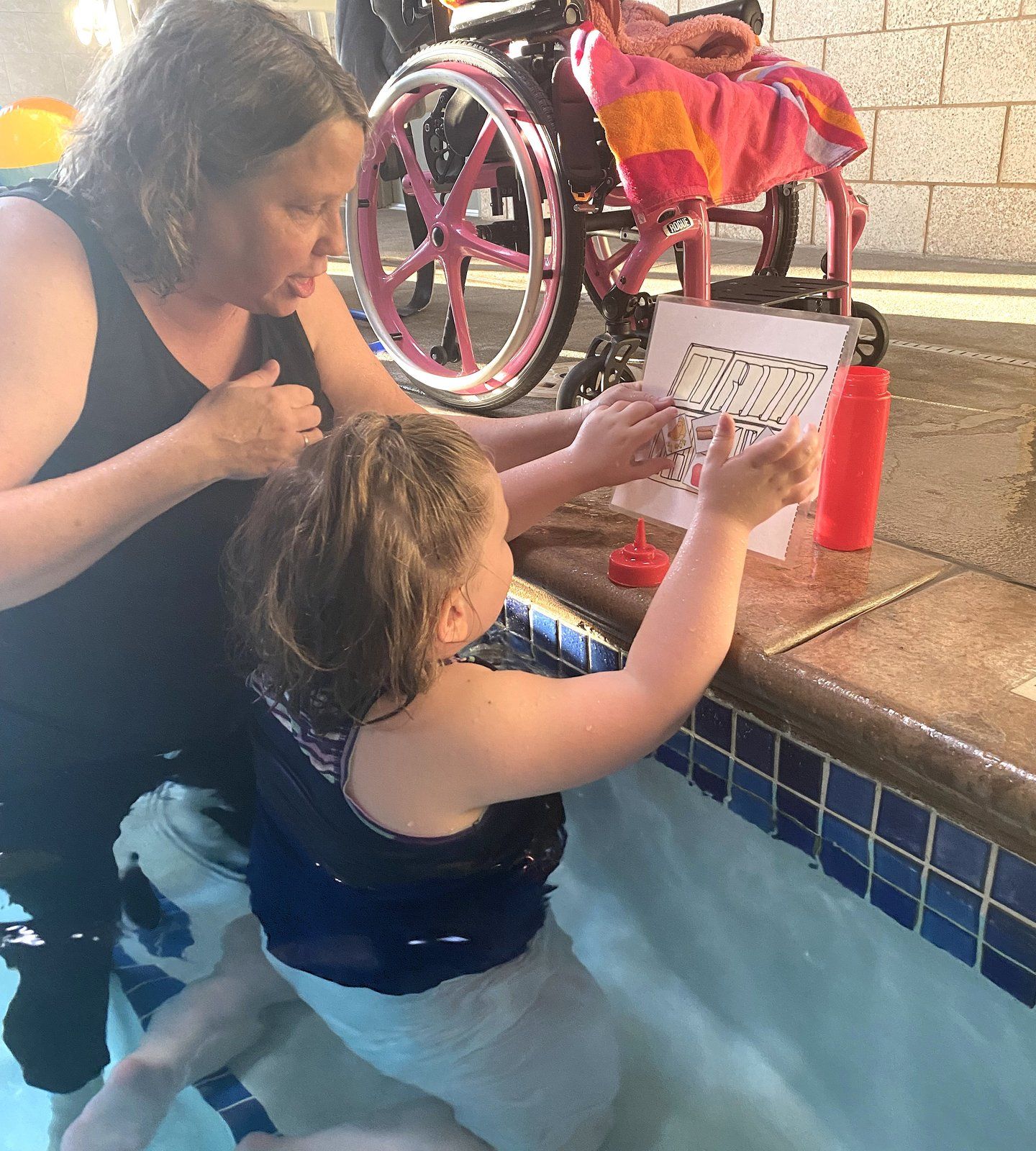
The setting changes. The scope does not.
An SLP who provides therapy in water is still responsible for the same areas as on land: communication, language, speech, voice, cognitive-communication and swallowing. The environment changes. The scope of practice does not.
ASHA’s Scope of Practice in Speech-Language Pathology describes the profession by what SLPs do, in communication and swallowing, and calls itself a guide for SLPs “across all clinical and educational settings.”1 It doesn’t name pools, and it doesn’t need to. The goals come first; the pool is one more place to work on them. Who may treat in a pool, and how that care is billed, still depends on your state, your employer and your payer.
Speech-language therapy in a pool is still speech-language therapy. The SLP sets the same communication and swallowing goals as on land; the water changes how the body behaves while the patient works on them.
What the water changes
Five properties of water do most of the work: buoyancy, hydrostatic pressure, viscosity, turbulence and temperature. Each one changes the body an SLP is working with.
Hydrostatic pressure and the breath
Water presses on everything below the surface, and the pressure grows with depth.2 In head-out immersion, that pressure squeezes the chest wall. Breathing takes more work, and vital capacity falls.3,4 In a 2025 study, 10 healthy young adults cycled in water and on land at the same oxygen uptake. In the water, their expiratory reserve volume was lower, and at moderate effort they breathed faster and moved more air.5
The water also gives continuous touch input over the whole immersed body. For some patients, that combination opens a chance to work on breath support, phonation and prosody under different physiologic demands than on land. [Expert opinion]
“Some” matters. The same added load is a reason for caution. The rise in pressure in the lung circulation during immersion carries a potential for pulmonary edema,3 so depth, entry into the water and session length belong in the plan for anyone with heart or lung disease. Medical status comes first.
Buoyancy and posture
Buoyancy offsets much of the body’s weight, and the deeper the immersion, the more weight it takes off.4 Some patients can hold an upright posture in the water that they can’t hold on land. [Expert opinion]
That matters because posture and swallowing are linked on land. A review of postural control for feeding describes head stability as the base for jaw control, and head control as depending on trunk alignment and a stable pelvis.6 In five children with cerebral palsy, poor head control and poor trunk stability, changing trunk and neck position reduced aspiration on videofluoroscopy.7
Picture a patient who can’t sit on their own on land. In the water, with the right support, that patient may be upright and face to face with a communication partner, with the breath support to vocalize. [Expert opinion] Whether upright posture in the pool improves swallowing has not been studied; see What the research says.
The environment changes. The scope of practice does not.
Andrea Salzman, MS, PT, founder of Aquatic Therapy University
Viscosity, turbulence and warmth
Water resists movement, and moving water pushes back. When a patient or the water around them moves, posture and head position can shift. The SLP needs to know how these forces act on the patient’s body before planning activities around them. [Expert opinion] Water temperature affects comfort and how the body responds; the Encyclopedia entry on thermal effects of immersion explains the basics.
Safety comes first
Safe handling and positioning are just as essential for the SLP in the pool as for any other clinician. To work safely, the SLP needs to understand:
- how buoyancy, turbulence and hydrostatic pressure act on the patient’s body;
- how to position and support the patient so the head and airway stay safely controlled;
- aquatic handling, transfers and patient support techniques;
- patient selection, basic contraindications, environmental awareness and the therapist’s responsibilities; and
- when a patient should not enter the water at all.
Competence in aquatic handling, transfers, positioning and patient support is a core safety requirement for any clinician working in water. SLPs are no exception. [Expert opinion]
What the research says
Research on speech and language therapy in water is small and mostly involves children on the autism spectrum:
- The ASLT program. Children on the autism spectrum who had aquatic speech and language therapy improved significantly more on vocabulary measures than a matched group who had a similar classroom-based program. The study was not randomized.8
- A 2026 pilot. Ten children on the autism spectrum aged 3 to 5 had 12 months of individualized, water-based communication therapy built on the SCERTS model. Their average number of intentional communicative acts rose from 7.8 to 24.8, and there was no control group.9
- Coaching a parent. In a single-case study, a father coached by telehealth and during pool sessions learned two of three responsive communication strategies, and his 5-year-old used a few more spontaneous single words.10
- A team approach. A 2025 study of 80 people with intellectual disability aged 9 to 66 combined physical therapy, occupational therapy, speech therapy and therapeutic pedagogy in aquatic therapy and reported gains, including in communication.11
- In practice. A 2015 ASHA Leader profile describes an SLP’s six-week pool group for young children with autism and other disabilities, using singing, toys and bubbles.12
What’s missing: a PubMed search on October 22, 2026 found no studies of therapy in water for swallowing, aphasia, dysarthria or stuttering.14 The ideas about breath support, posture and safety in this post are clinical reasoning from the physiology [Expert opinion], not tested treatments.
Not the same thing: “water resistance therapy” in voice work means phonating through a tube into a container of water. It is a voice technique, not therapy in a pool.13
Frequently asked questions
Can a speech-language pathologist provide therapy in a pool?
Yes, when it fits the patient and local rules allow it. The SLP’s job does not change in the water: it is still communication and swallowing. ASHA’s Scope of Practice describes itself as a guide for SLPs across all clinical and educational settings (ASHA, 2016, Scope of Practice in Speech-Language Pathology, reference 1).
How does water affect breathing?
Water pressure on the chest wall makes breathing more work and lowers vital capacity in head-out immersion (Pendergast et al., 2015, Compr Physiol, reference 3). That changes the conditions for breath support and voice practice, and it is also a reason for caution in heart and lung disease.
Is there research on speech and language therapy in water?
A little. The named ASLT program improved vocabulary more than a similar classroom program in children on the autism spectrum (Sourvinos et al., 2021, J Autism Dev Disord, reference 8). Most studies are small and involve autism.
Has pool therapy been studied for swallowing problems?
Not yet. A PubMed search on October 22, 2026 found no studies of therapy in water for swallowing, aphasia, dysarthria or stuttering (reference 14). Patients with swallowing or airway problems need careful screening and positioning before any pool session.
References
Sources cited in this post
Numbers match the citation numbers in the text. [Expert opinion] marks clinical reasoning from Aquatic Therapy University that has not been tested in published studies.
- American Speech-Language-Hearing Association. Scope of Practice in Speech-Language Pathology [policy document]. 2016. Accessed October 22, 2026. https://www.asha.org/policy/sp2016-00343/
- ReviewTorres-Ronda L, Schelling i del Alcázar X. The Properties of Water and their Applications for Training. J Hum Kinet. 2014;44:237-248. doi:10.2478/hukin-2014-0129. PubMed: 25713684. Free full text: PMC4327375.
- ReviewPendergast DR, Moon RE, Krasney JJ, Held HE, Zamparo P. Human Physiology in an Aquatic Environment. Compr Physiol. 2015;5(4):1705-1750. doi:10.1002/cphy.c140018. PubMed: 26426465.
- ReviewBecker BE. Aquatic Therapy: Scientific Foundations and Clinical Rehabilitation Applications. PM R. 2009;1(9):859-872. doi:10.1016/j.pmrj.2009.05.017. PubMed: 19769921.
- Hoshi D, Fukuie M, Tomoto T, Qin W, Tarumi T, Sugawara J. Respiratory regulation and lung volume during aquatic and land-based exercise in healthy young adults. Physiol Rep. 2025;13(19):e70564. doi:10.14814/phy2.70564. PubMed: 41017519. Free full text: PMC12477437.
- ReviewRedstone F, West JF. The importance of postural control for feeding. Pediatr Nurs. 2004;30(2):97-100. PubMed: 15185730. (No DOI.)
- Larnert G, Ekberg O. Positioning improves the oral and pharyngeal swallowing function in children with cerebral palsy. Acta Paediatr. 1995;84(6):689-693. doi:10.1111/j.1651-2227.1995.tb13730.x. PubMed: 7670257.
- Sourvinos S, Mavropoulos A, Kasselimis DS, et al. Brief Report: Speech and Language Therapy in Children with ASD in an Aquatic Environment: the ASLT (Aquatic Speech and Language Therapy) Program. J Autism Dev Disord. 2021;51(4):1406-1416. doi:10.1007/s10803-020-04629-7. PubMed: 32748193.
- Alegria R, Rocha J, Nachimson S, et al. Water-based communication intervention integrating SCERTS for young children with autism: an explanatory sequential mixed-methods pilot study. Int J Dev Disabil. Published online May 28, 2026:1-12. doi:10.1080/20473869.2026.2676144.
- Flippin M, Clapham ED. Using a Hybrid Telehealth and Adaptive Aquatics Father Coaching Intervention for Children with Autism Spectrum Disorder: A Pilot Study. Int J Disabil Dev Educ. 2023;70(6):1222-1243. doi:10.1080/1034912X.2021.1961212.
- Rodriguez Carrión S, Martínez Beltrán MJ, Navarro Meléndez A, et al. Transdisciplinary aquatic therapy enhances developmental outcomes for people with intellectual disabilities. Int J Dev Disabil. Published online June 4, 2025:1-12. doi:10.1080/20473869.2025.2505996.
- Practice reportBlum H. Water Works: An SLP takes a dip into pool group treatment sessions for clients with autism and other disabilities. ASHA Leader. 2015;20(12):26-27. doi:10.1044/leader.LML.20122015.26.
- Horáček J, Radolf V, Laukkanen AM. Impact Stress in Water Resistance Voice Therapy: A Physical Modeling Study. J Voice. 2019;33(4):490-496. doi:10.1016/j.jvoice.2018.01.025. PubMed: 29884510.
- SearchPubMed search run October 22, 2026 for pool, aquatic, hydrotherapy or water-based therapy in titles and abstracts combined with dysphagia, swallowing, aphasia, dysarthria or stuttering; 31 records, none a study of therapy for these conditions in water. Run the search on PubMed.
How to cite this article
Published October 23, 2026 · Permanent URL: https://www.aquatictherapyuniversity.com/blog/water-is-the-classroom-speech-language-therapy-in-the-pool
How to cite
Aquatic Therapy University. (2026, October 23). Water Is the Classroom: Speech-Language Therapy in the Pool. From the Deep End. https://www.aquatictherapyuniversity.com/blog/water-is-the-classroom-speech-language-therapy-in-the-pool
Permissions: You may quote and cite this article with attribution. Reproducing or adapting the full article requires written permission from ATU Educational Services, LLC.
Copyright: © 2026 ATU Educational Services, LLC.
For education only; not a substitute for individual clinical judgment. Treating in a pool depends on each patient’s medical status and on local licensing, facility and payer rules.