
From The Deep End · ATU Blog
Why Water Can Bring Children Hope
How one pediatric clinic uses the pool, a sample session with a young girl who uses a walker, and why aquatic therapy can be a turning point for children.
First published April 10, 2024 on atuseminars.comThis is a blast from the past, but the message holds. Children who can't stand on one foot on land are often thrilled by what they can do in the water.
Want to go deeper? Explore the Pediatric Aquatic Therapy bundle →
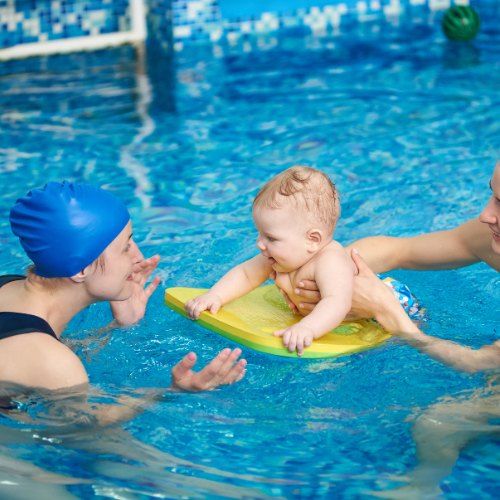
A blast from the past. Here is one of the 300+ aquatic articles our team has written for Advance magazine over the last 10 years. The Advance magazine archives are no longer available online, so we are preserving them here.
Pediatrics and aquatic therapy are often a natural mix. I don't think it takes the place of land-based therapy — nor should it — but it can be the turning point for many kids.—Kiki Mayer, PT
Ask Kiki Mayer, PT, what she thinks about putting children with disabilities in the pool and you'll hear an earful.
"Everyone here works in the pool — PTs, OTs, even speech therapists. It's a critical part to some kids' therapy because it's incredibly motivating. The children don't even know they are working," Mayer said.
According to Mayer, who works at Special Children Center, a privately owned therapy center in Hudson, WI, kids who can't even stand on one foot on land are thrilled because they can in the pool.
"I don't think it takes the place of land-based therapy—nor should it—but it can be the turning point for many kids," she said. "I think therapists who don't have training in aquatics sometimes think, 'What a hassle.' They look at the child and say to themselves, 'I've got to get him into a bathing suit? It's not happening.' But once therapists learn how awesome the water can be, how soothing for the therapist and engaging for the child, they change their minds. They see the value in struggling over the little things."
Terry M. Petersen, MS, PT, owner of Aquatic Physical Therapy, L.L.C., Leawood, KS, agree. Since 1993, Petersen has devoted 100 percent of her pediatric practice to aquatics, so she's in a perfect position to judge. She believes that aquatic PT is valuable for children for whom land-based treatment fails to provide adequate motivation, or for children who require a more "gravity-friendly" environment. Irrespective of the child, however, she warned that aquatic PT goals must be closely related to land-based needs.
Petersen said that both the Halliwick method and NDT principles are foundations for effective handling in water, but she does not incorporate many of the latest techniques, such as Watsu ®.
"I use very little of the adult-based aquatic interventions, such as Watsu and Bad Ragaz," said Petersen. "I fail to see the relationship between the achievement of pediatric outcomes and adult interventions, which are developed primarily to manage painful symptoms." Petersen also said she does not often use passive techniques; instead, she relies on engaging children in meaningful activities to improve functional skills that clearly relate to land-based outcomes.
A Sample Treatment Session At Special Children Center (SCC), an aquatics session typically runs between 30 and 60 minutes. Since SCC's pool does not have an entry ramp (an item on Mayer's "wish list" for the pediatric pool), therapists often lift their patients into the pool. A session with "Lisa," a 3-year-old with triplegia cerebral palsy, begins this way.
Since Lisa only uses a walker to walk very short distances and is gravitationally insecure, Mayer holds her initially without an flotation device in the water. She then progresses to using a float ring, where Mayer can distance herself from Lisa, allowing the child a sense of accomplishment while still providing contact-guard assistance.
"A huge portion of the session is spent working on elongating trunk and pelvis musculature," said Mayer. After gaining range, Lisa is better able to perform bilateral kicking as a precursor for reciprocal gait and other loaded activities. "Mostly, she's motivated by cooking—she pretends she's making something for me. So we sit on the steps in the 90/90 position (90 degrees hip flexion, 90 degrees knee flexion, like sitting on a chair) and cook up a feast."
At the end of the session, Lisa climbs out (a new skill; she just recently has been able to flex enough at the hip) and lowers herself into the hot tub.
"She loves the hot tub—she would be in there the whole time, but we limit it to 5 to 10 minutes because of thermoregulation issues with children," Mayer said. She said some children (such as those with a history of seizures) are not allowed in the warmer tub. The 101-degree water is warmer than thermoneutral (the temperature at which the water and the skin are equal, so no thermal shift occurs from one to the other—typically considered about 94 degrees), so Mayer can work on manual stretching with the added bonus of superficial heat. Since most hot tubs are the right depth for three-quarter support, therapists often use them for weight-bearing tasks and then translate the work to land-based functional tasks.
The Future for Pediatric Aquatic Therapy Although many clinics find aquatic therapy to be a popular choice among their pediatric clientele, there is not an overwhelming amount of scientific support for the procedure. Matthew Schaeffer, PT, who works with the Easter Seals Society in Stockton, CA, first became interested in aquatics after graduation.
"It was an area I never learned about in PT school," he said. "And then, once I started working in the water, I couldn't find much in the journals to support aquatic therapy." This prompted Schaeffer to propose a research study that would examine the effect of aquatic therapy on children's ability to maintain head and neck control.
"Aquatics is such a relatively unexplored environment," he concluded. "It deserves our attention. I'd like to see more PTs work to expand the evidence-base that supports it."
What the research says now
When this article was written, Matthew Schaeffer could find little research. There is more now, though it is still thin.
- Cerebral palsy. A 2025 meta-analysis of 15 trials (369 children) found low-quality evidence that aquatic physical therapy improved gross motor function more than land exercise, with a small effect. Halliwick and swimming programs showed no significant difference from land.5
Most trials were small and at high risk of bias. The pool adds to land therapy; it does not replace it.
Frequently asked questions
Why do children with disabilities enjoy the pool?
In the water, children who cannot balance on one foot on land can suddenly do much more (Aquatic Therapy University, 2024).
Which methods guide pediatric handling in water?
Halliwick and NDT principles, with little use of adult methods such as Watsu and Bad Ragaz (Aquatic Therapy University, 2024).
Are pediatrics and aquatic therapy a good fit?
Often, yes. Children and the pool tend to go together naturally (Aquatic Therapy University, 2024).
References
Further reading (from the original article)
- BookCampion MR, ed. Hydrotherapy: Principles and Practice. Oxford: Butterworth-Heinemann; 1997.
- BookLangendorfer SJ, Bruya LD. Aquatic Readiness: Developing Water Competence in Young Children. Champaign, IL: Human Kinetics; 1995.
- BookLepore M, Gayle GW, Stevens SF. Adapted Aquatics Programming: A Professional Guide. Champaign, IL: Human Kinetics; 1998.
- BookAUSTSWIM. Teaching Infant and Preschool Aquatics: Water Experiences the Australian Way. Champaign, IL: Human Kinetics; 2000. (Listed in the original as Ure C, Kilpatrick J.)
Newer research
- Systematic review and meta-analysisPauluka E, Ceolin LS, Fontanela LC, Dos Santos AN. Aquatic Compared With Land-Based Exercises on Gross Motor Function of Children/Adolescents With Cerebral Palsy: A Systematic Review With Meta-Analysis. Child Care Health Dev. 2025;51(1):e70023. doi:10.1111/cch.70023. PubMed: 39688349.
How to cite this article
First published April 10, 2024 on atuseminars.com · Last updated October 19, 2026 · Permanent URL: https://www.aquatictherapyuniversity.com/blog/why-water-can-bring-children-hope
How to cite
Aquatic Therapy University. (2024, April 10). Why Water Can Bring Children Hope. Aquatic Therapy University Blog. ATU Educational Services, LLC. https://www.aquatictherapyuniversity.com/blog/why-water-can-bring-children-hope
Permissions: You may quote and cite this article with attribution. Reproducing or adapting the full article requires written permission from ATU Educational Services, LLC.
For education only; not a substitute for individual clinical judgment.