
From The Deep End · ATU Blog
Using Aquatic Therapy to Promote Social Interaction
How aquatic therapists, an OT and a speech-language pathologist use the pool to build social interaction in children with autism and other disabilities.
First published May 15, 2024 on atuseminars.comRafaela had never spoken until a classmate in a Lisbon therapy pool kept asking whether she could talk. Her story, and those of the therapists here, show how much social growth can happen in the water.
Want to go deeper? Explore the Pediatric Aquatic Therapy bundle →
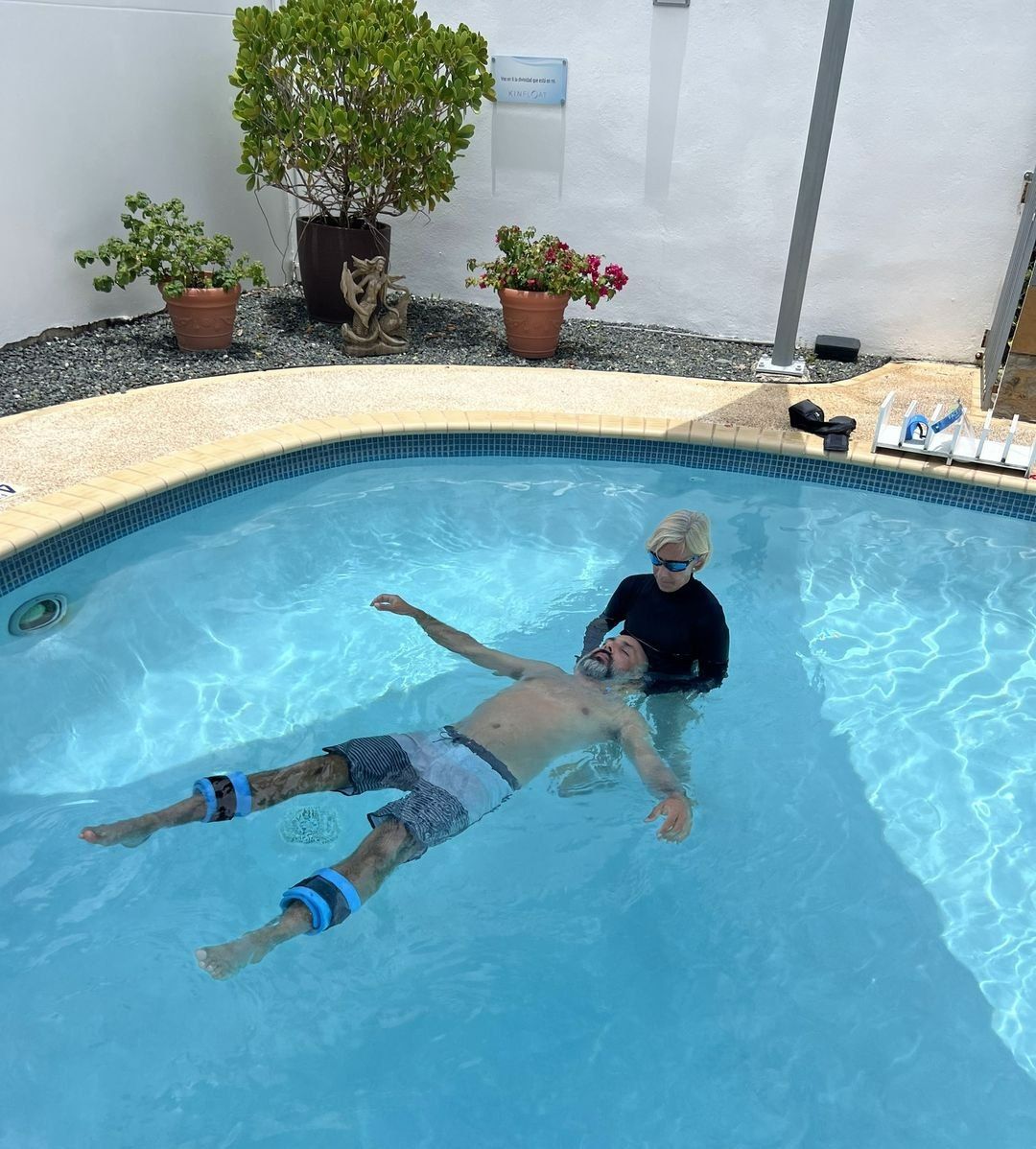
Maria first met Rafaela in a therapeutic pool in Lisbon, Portugal. Maria was visually impaired; Rafaela had been diagnosed with severe autism and she had never spoken. These two little ones crossed paths only because they attended adapted swimming classes back-to-back.
Maria loved to question and every week, she would inquire of her teacher “Does Rafaela knows how to talk?” to which the reply would follow “Not yet, Maria, not yet.”
Week after week this continued. Until one day Maria asked again “Does Rafaela knows how to talk?” to which the reply came once again “Not yet.” But Maria answered “I know Rafaela can talk. Yes, I know she can talk. Rafaela say ‘Hi’ to me”.
So Rafaela obliged. She said ‘Hi' to her friend Maria. She said ‘Hi’ in a pool in Portugal.
For the first time in her life.
Promoting Socialization
For many children like Rafaela, abnormal or absent social interactions are the painful realities of life with a disability such as autism. And although communication and social interaction per se may not be physical therapy goals, PTs and PTAs who incorporate these elements into more classic physical tasks (such as balance, kinesthesia and gross motor tasks) will reap exponential rewards.
Rita Gomes da Costa (Maria and Rafaela’s adapted aquatics instructor) is one of many professionals who believe strongly in the power of the pool to normalize friendships and social interactions.
da Costa recognizes that the therapy pool can be a daunting place for children with sensory integration issues.
“I have found these children seek out a comfort place in the pool – a place where they feel the safest. So we work from that place, leave for a little bit to play with others, than return to our safe spot.”
Kari Valentine, OTR/L, Owner of Wholistic Therapy Services (Hastings, Nebraska) concurs with the benefit of “child helping child”. She intentionally creates situations where children must work together to succeed in the water.
For instance, when working with children with Asperger’s Syndrome, Valentine has noticed her patients tended to work in solitude even when surrounded by others. Her desire? To encourage her patients who prefer to solve problems on their own to work together.
“I might give two children a water stilt. They would then have to work together, each having only one stilt, to pick up a ball between the two.”
Picture the two stilts (or crutches) lying on the surface of the water with the floating ball positioned between them. The children have to work together to squeeze the ball between their two stilts, pick it up, lift it above their heads and carry it to a target site.
Chris Kemp (Speech Language and Learning Place, Hastings, Nebraska), is a speech and language pathologist who deals daily with her little patients’ tendencies towards withdrawal. In order to “shut out the world” and “open up a 1:1 relationship” she will couple a child on the autistic spectrum with another child of similar age who is developing more typically. She finds this partnering especially important when working in a public pool which is open to the distractions of lap swimmers and group classes.
Some aquatic therapists have found role-playing scenes from books or a beloved movie a natural way to encourage interaction. Karen Reckamp, OTR/L, ATP (Wolfson Children’s Rehabilitation, Jacksonville, Florida) tapped into the Harry Potter phenomenon with one 7-year old female fan.
“We would act out some of the best Potter moments,” recalls Reckamp. “One of her favorite re-enactments was when we used the large dumbbell as a broomstick to chase the bad guy away (usually me!).”
Her patient would also use the dumbbell as a pogo stick and have races to outrun dragons and Death Eaters and the like. The rewards? Enhanced body awareness, balance, and the ability to adapt to changes in the plot of a verbal story -- as well as to engage in creative play.
Often times the pool is such a natural place for play that children wildly exceed their parents’ socialization expectations. Susan Nachimson, SLP (Speech-Language Pathology Services, Garberville, California) describes one of her favorite moments as a therapist. She had attended a pool party for several 5-6 year old children, two on the autistic spectrum. The whole crew piled into the pool and she soon found one boy in her arms vying for her attention. She began a game of “Here or There?” where she would point to two opposing places in the water thus asking the boy where he wished to be tossed.
Nachimson remembers, “He began to point and say either ‘Here!’ or ‘There!’ so I added more choices such as ‘By the side?’ or ‘By the steps?’ After a while I looked up and noticed his parents -- mesmerized -- watching their son and hearing him use words and communicating clearly about his choices.”
The game extended into Nachimson taking turns with the other children who also wanted to choose “Here or there?” and soon the children were all playing -- together. Once childhood morphs into adolescence, friendships and friendly competition are not the only driving motivations. Karen B. McPhee, a Certified Therapeutic Recreation Specialist out of Portland, Maine, describes the power of a well-placed peer of the opposite sex.
Her client Susie was a high-school student with autism. She wasn’t showing much desire to be in the therapy pool. “But when two other students joined our group – boys! -- Susie’s interest was piqued,” laughs McPhee. “She began to search them out with her eyes, keeping track of where they were in the water while she swam in proximity.” Even better? They were watching Susie, too.
Conclusion
Water activities can provide autistic children with the opportunity to socialize and form attachments. It helps that pool-time seems less like “therapy” and more like fun for the children. For additional, practical ways to integrate group play into your pool work, check-out the “How to Encourage Social Interactions” sidebar.
SIDEBAR
How do you encourage social interactions during your aquatic treatment?
Facing social deficits with your pediatric patients? Try some of these well-tested methods for working group play and social interactions into your pool time.
Your 4-year old patient only communicates with a picture book and does not speak.
Take two toy trumpets into the pool. Have the boy blow into his trumpet right above the water’s surface. Blow your trumpet back as an “answer” to his “trumpet talk”. The sound may scare or amaze so keep it slow. While your patient is busy blowing, lower both trumpet bells into the water and watch the sound evolve into bubbles (“visual sound”). Take turns “speaking” with bubbles. Have your patient blow harder and harder until a moment comes when the trumpet gets blown away and the child is making bubbles directly into the water. This pursed lip and breathing activity can be used as a precursor to making speech sounds and the turn-taking grasped is a necessary part of social interaction. [Yifat Cohen, SLP and Hydrotherapist, Alyn Rehabilitation Center for Children, Jerusalem, Israel].
Your 7-year old patient cries every morning when faced with the need to decide and communicate what he wants to eat for breakfast. The stress of the interaction makes him withdraw from the kitchen table. Start your pool session with a game of Going to the Lego Store. Float pictures of recognizable Lego parts (for instance, Thomas the Train) on the water’s surface. Have your patient swim to the picture, look at it, say the word of the part depicted (if possible), and then swim over to the “Parts Store” operated by a lifeguard, PT or OT on the side of the pool. At the Parts Store, he will look to find the right matching piece (for instance Thomas’s wheels, body, or engine) and then must either hand the card to the Parts Manager or ask for the part by name. The goal? To have your patient “buy” all the right parts through a give-and-take interaction with the Parts Manager -- and then to physically build the train. [Karol Pickerill, MS/CCC-SLP-L; Speech Language and Learning Place, Hastings, Nebraska]
Your 8-year old patient will not share toys or play interactively.
Tap into a theme which resonates with the child. For instance, if monster trucks are an obsession, make the entire session a Monster Truck Rally. Allow your patient to bring his favorite monster truck into the pool and show him how to drive the truck over the bridge (floatation mat) or under the tunnel (noodle) after paying a toll to the toll-booth operator (you or another child).
Or choose one child to be the Monster Truck Race Official and play “Red Light, Green Light”. The game starts with the Race Official facing away from the other players. He yells, "Green light!" and counts to five out loud as quickly as he can. The other players must swim quickly toward the Race Official while he counts. When the Race Official has counted to five, he shouts, "Red Light!" and the players must stop advancing instantly or be eliminated from the game. [Melissa Moos, DPT, Wholistic Therapy Services,
Hastings, Nebraska]
What the research says
- Social gains are measurable. In a controlled trial, a 10-month aquatic program for children with autism, which ended with a social integration phase, improved functional adaptation, emotional response and activity level more than in controls.1
- A 2024 review agrees. Across 19 studies (429 children aged 3 to 17), aquatic programs improved motor and social skills and reduced autistic behavior.2
The stories in this article are the therapists’ own accounts, not study results. The trials are small, but they point the same way.
Frequently asked questions
Can water activities help autistic children socialize?
Yes. Activities in the water can help these children socialize and form attachments (Aquatic Therapy University, 2024).
Should PTs include communication and social goals in pool sessions?
Yes. Even if they are not PT goals in themselves, building communication and social interaction into balance and gross motor work pays off (Aquatic Therapy University, 2024).
References
Research cited in this post
- Caputo G, Ippolito G, Mazzotta M, et al. Effectiveness of a Multisystem Aquatic Therapy for Children with Autism Spectrum Disorders. J Autism Dev Disord. 2018;48(6):1945-1956. doi:10.1007/s10803-017-3456-y. PubMed: 29313176.
- Reviewvan T Hooft P, Moeijes J, Hartman C, van Busschbach J, Hartman E. Aquatic Interventions to Improve Motor and Social Functioning in Children with ASD: A Systematic Review. Rev J Autism Dev Disord. 2026;13(3):751-771. doi:10.1007/s40489-024-00464-z. PubMed: 42756010.
How to cite this article
First published May 15, 2024 on atuseminars.com · Last updated October 19, 2026 · Permanent URL: https://www.aquatictherapyuniversity.com/blog/using-aquatic-therapy-to-promote-social-interaction
How to cite
Aquatic Therapy University. (2024, May 15). Using Aquatic Therapy to Promote Social Interaction. Aquatic Therapy University Blog. ATU Educational Services, LLC. https://www.aquatictherapyuniversity.com/blog/using-aquatic-therapy-to-promote-social-interaction
Permissions: You may quote and cite this article with attribution. Reproducing or adapting the full article requires written permission from ATU Educational Services, LLC.
For education only; not a substitute for individual clinical judgment.