
From The Deep End · ATU Blog
Part 2 of 2Rheumatological disorders: Joint, tissue, and motor pain (Part 2 of 2)
Part 2: what early studies found when people with rheumatoid arthritis, juvenile arthritis, fibromyalgia and osteoarthritis exercised in the water.
First published April 17, 2024 on atuseminars.comPart 1 made the case from physics. Part 2 asks the harder question: what happened when researchers actually put people with rheumatologic disorders in the water?
Want to go deeper? Explore the Aquatic Therapy for Arthritis, Osteoporosis & Sarcopenia course →
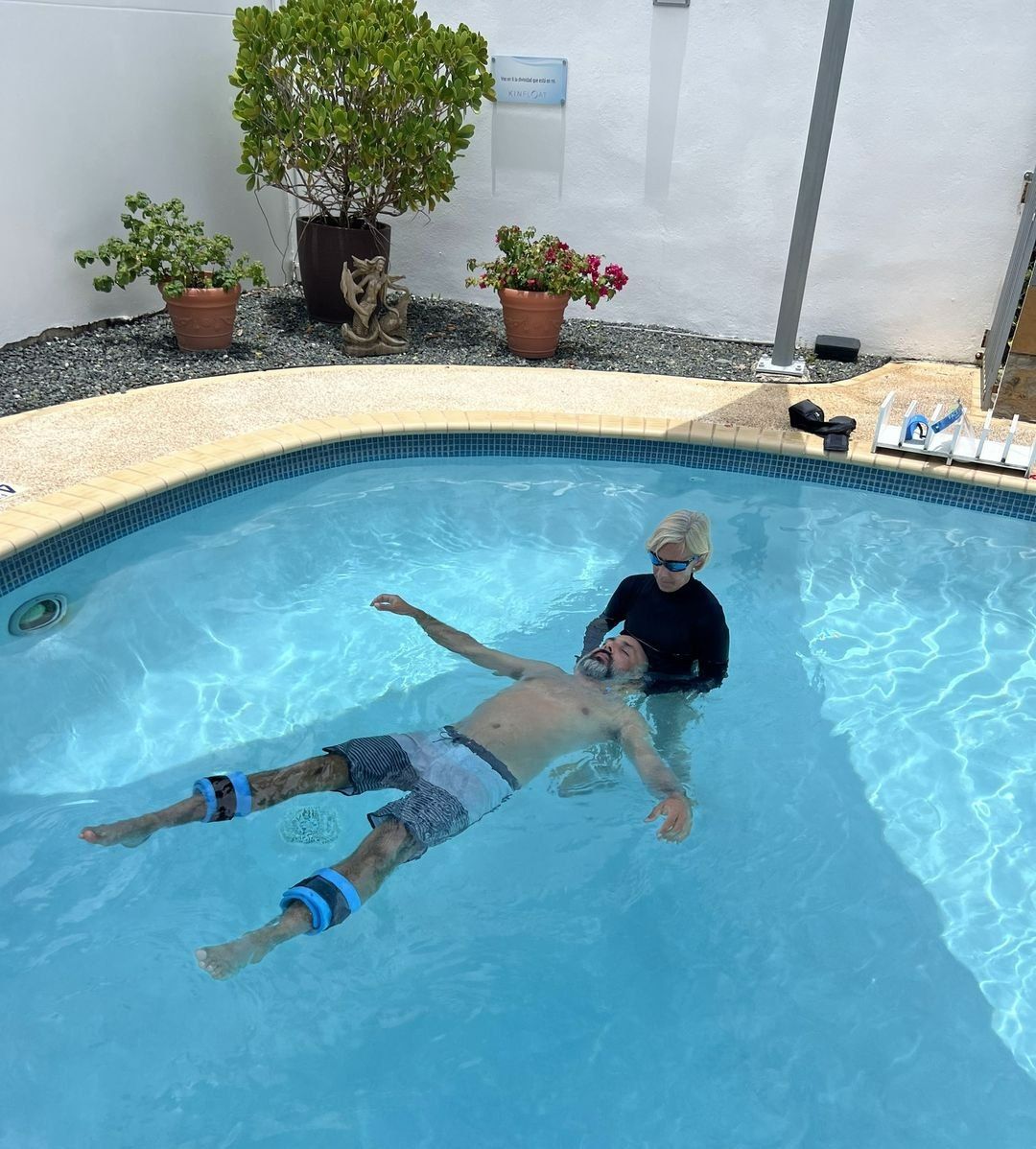
Part 1 covered the hypothesized benefits and the hydrodynamic principles (buoyancy, viscosity and flow) behind aquatic therapy for rheumatologic disorders. Read Part 1.
II. Scientific research
Although the beginnings of a solid case can be made based on hydrodynamic principles alone, there has also been some research that has examined whether aquatic therapy can increase flexibility, strength, and movement quality/quantity in rheumatology patients.
Dial and Windsor examined the combined effects of an 8-week health education/water exercise class for 12 adults with rheumatoid arthritis. [1] Self-report tools indicated that the subjects had improved in functional status, pain, mobility, tenderness in joints, joint movement, number of recent flare-ups and treatment expectations. There was no significant improvement in ADL outlook. Objective findings showed significant improvement in the following: shoulder, elbow and wrist AROM, ability to flex digits to palmar crease, hip and knee AROM, and timed tests for arise-walk-sitting, walking 50-feet times, and donning/removal of shirt. The subjects did not show significant improvement in grip strength, morning stiffness, ankle AROM or MCP extension.
In a study by Danneskiold-Samsoe et al, subjects diagnosed with functional class II or III participated in an aquatic exercise program 2x/week for 2 months. [2] After 2 months of exercise participation, maximal isometric and isokinetic strength of the quadriceps increased by 38 percent and 16 percent, respectively.
Bacon et al examined the effects of an aquatic exercise program on individuals diagnosed with JRA (functional class I-III). [3] There were significant ROM improvements in bilateral hip internal rotation, and right hip flexion with knee extended. Trends toward increased plantar flexion ROM were also noted but not significant. There were no significant improvements in balance or timed tasks. There were no significant differences (although a trend was evident) toward increased gait cadence, velocity and stride length.
Templeton et al examined the objective changes in joint flexibility and functional ability in rheumatologic populations after participation in an aquatic therapy program. [4] Measurements of joint ROM and functional ability measured by the Functional Status Index (FSI) were determined pre- and post-aquatic exercise. Psychosocial factors were emphasized by encouraging members to share benefits, joys, and accomplishments prior to each class session. Following the eight-week aquatic program, joint ROM measurements and functional ability (FSI) significantly improved. Aquatic therapy was identified as an effective treatment for improving quality of life in this population. There was no significant improvement in the subjects' ratings of "need for assistance" with daily functional tasks.
Stenstrom et al examined the effects of a 1x/week aquatic exercise class for 30 subjects with class II RA over a 4-year span. [5] After four years of training 1x/week, the following significant improvements were evident in the training group: grip strength, frequency of exercise and frequency of hospitalization in the department of internal medicine. Additionally, the control group attended supplemental physiotherapy visits more often than the training group (34 visits and 21 visits, respectively). At the two-year follow-up, the training group remained significantly more active and more likely to exercise than the control group. A majority of the training group continued to independently perform intensive, dynamic water training even though this was not offered as a service through the study. All but one subject in the training group rated the long-term benefits of the 1x/week training as "important" or "rather important."
Jentoft et al [6] examined the effects of pool-based (PE) and land-based (LE) exercise programs on patients with fibromyalgia. The outcomes were assessed by the Fibromyalgia Impact Questionnaire, the Arthritis Self-Efficacy Scale, and tests of physical capacity. After 20 weeks, greater improvement in grip strength was seen in the LE group compared with the PE group, although both improved. The results were mainly unchanged at 6 months follow-up.
Green and colleagues [7] assessed the treatment effectiveness of home exercise alone versus the effectiveness of home exercises plus hydrotherapy for osteoarthritis of the hip. The authors examined range of motion (goniometry), muscle strength (dynamometry), and functional abilities (transfer times, walking speed and number of steps required for a fixed distance, and stair climbing/descent speeds). Weeks 0-6 were used to establish a baseline. There was no significant difference of any parameters over this period. Weeks 9-12 were used to examine treatment effects compared to the baseline information. Subjects in both group 1 and 2 showed highly significant improvement in the combination of parameters tested. Final visit: This improvement continued over the next 6 weeks and the final assessment (week 18) showed marked improvement over control values for both the land only and the aquatic-plus-land groups. The elements most affected by both interventions were joint stiffness, hip external rotation, hip abduction power/endurance, the number of steps necessary to travel a distance and to ascend/descend a set of steps. The authors found no significant difference in the treatment results obtained by the self-treatment group and the self-treatment plus hydrotherapy group. However, this was not a comparative study.
Conclusion
This column attempts to establish the beginning of a hydrodynamic and scientific basis for the use of aquatic therapy to improve the strength, flexibility and quality and quantity of movement in patients with rheumatology disorders. Part III will examine the beneficial effects of aquatic therapy on decreasing pain and muscle spasms.
What newer research says
- Osteoarthritis. A Cochrane review found aquatic exercise gave a small, short-term improvement in pain, disability and quality of life in knee and hip osteoarthritis.8
- Inflammatory arthritis. A 2022 systematic review (9 studies, 604 people) found aquatic exercise helped pain, disease activity and physical function in rheumatoid arthritis and spondyloarthritis, but could not show it beats other exercise.9
The studies above are small and early. Newer reviews agree that water exercise helps, but not that it beats land exercise.
Frequently asked questions
Does aquatic therapy improve quality of life in rheumatologic patients?
Yes. The studies reviewed point to aquatic therapy as an effective way to improve quality of life in this group (Aquatic Therapy University, 2024).
What did Dial and Windsor find?
Their small group of adults with rheumatoid arthritis said they functioned better, hurt less and flared less often after the 8-week program (Dial & Windsor, 1985).
References
References
- Dial C, Windsor RA. A formative evaluation of a health education-water exercise program for class II and III adult rheumatoid arthritis patients. Patient Educ Couns. 1985;7(1):33-42. doi:10.1016/0738-3991(85)90017-5.
- Danneskiold-Samsøe B, Lyngberg K, Risum T, Telling M. The effect of water exercise therapy given to patients with rheumatoid arthritis. Scand J Rehabil Med. 1987;19(1):31-5. PubMed: 3576139.
- Bacon MC, Nicholson C, Binder H, White PH. Juvenile rheumatoid arthritis. Aquatic exercise and lower-extremity function. Arthritis Care Res. 1991;4(2):102-5. doi:10.1002/art.1790040207. PubMed: 11188589.
- Templeton MS, Booth DL, O'Kelly WD. Effects of aquatic therapy on joint flexibility and functional ability in subjects with rheumatic disease. J Orthop Sports Phys Ther. 1996;23(6):376-81. doi:10.2519/jospt.1996.23.6.376. PubMed: 8727018.
- Stenström CH, Lindell B, Swanberg E, Swanberg P, Harms-Ringdahl K, Nordemar R. Intensive dynamic training in water for rheumatoid arthritis functional class II--a long-term study of effects. Scand J Rheumatol. 1991;20(5):358-65. doi:10.3109/03009749109096812. PubMed: 1947899.
- Jentoft ES, Kvalvik AG, Mengshoel AM. Effects of pool-based and land-based aerobic exercise on women with fibromyalgia/chronic widespread muscle pain. Arthritis Rheum. 2001;45(1):42-7. doi:10.1002/1529-0131(200102)45:1<42::AID-ANR82>3.0.CO;2-A. PubMed: 11308060.
- Randomized controlled trialGreen J, McKenna F, Redfern EJ, Chamberlain MA. Home exercises are as effective as outpatient hydrotherapy for osteoarthritis of the hip. Br J Rheumatol. 1993;32(9):812-5. doi:10.1093/rheumatology/32.9.812. PubMed: 8369892.
Newer research
- Systematic review and meta-analysisBartels EM, Juhl CB, Christensen R, et al. Aquatic exercise for the treatment of knee and hip osteoarthritis. Cochrane Database Syst Rev. 2016;3(3):CD005523. doi:10.1002/14651858.CD005523.pub3. PubMed: 27007113.
- Systematic reviewMedrado LN, Mendonça MLM, Budib MB, Oliveira-Junior SA, Martinez PF. Effectiveness of aquatic exercise in the treatment of inflammatory arthritis: systematic review. Rheumatol Int. 2022;42(10):1681-1691. doi:10.1007/s00296-022-05145-w. PubMed: 35633390.
How to cite this article
First published April 17, 2024 on atuseminars.com · Last updated October 19, 2026 · Permanent URL: https://www.aquatictherapyuniversity.com/blog/rheumatological-disorders-joint-tissue-and-motor-pain-part-2
How to cite
Aquatic Therapy University. (2024, April 17). Rheumatological disorders: Joint, tissue, and motor pain (Part 2 of 2). Aquatic Therapy University Blog. ATU Educational Services, LLC. https://www.aquatictherapyuniversity.com/blog/rheumatological-disorders-joint-tissue-and-motor-pain-part-2
Permissions: You may quote and cite this article with attribution. Reproducing or adapting the full article requires written permission from ATU Educational Services, LLC.
For education only; not a substitute for individual clinical judgment.