
From The Deep End · ATU Blog
Building a Case for Treating Rheumatologic Patients with Aquatic Therapy
The hydrodynamic and research case for aerobic aquatic exercise in rheumatologic disorders, from buoyancy and hydrostatic pressure to five key studies.
First published May 27, 2024 on atuseminars.comOnce joints start to degenerate, exercise options shrink fast, and many patients stop exercising altogether. This article lays out the case, one argument at a time, for aerobic conditioning in the pool.
Want to go deeper? Explore the Aquatic Therapy for Arthritis, Osteoporosis & Sarcopenia course →
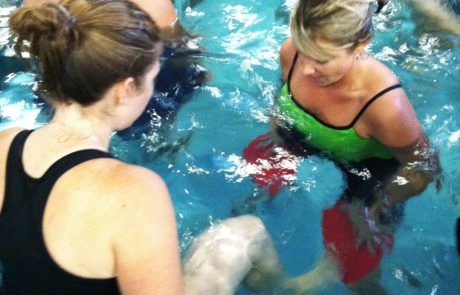
It is already widely accepted that one of the most effective treatments for long-term management of the symptoms of rheumatologic disorders is physical exercise. However, it has been suggested that weight-bearing exercise — even exercise considered "normal" — can aggravate pain and further promote degeneration in patients with abnormal joints. This is particularly true if the joints have incongruous articular surfaces, poor alignment, ligamentous instability, or altered muscle or joint innervation, as is often the case in patients with immunologic conditions.
Unfortunately, this diminishes exercise options for the patient with joint degeneration, which often results in a discontinuation of exercise altogether. Ironically, the ensuing immobility and lack of dynamic joint loading further damage joint surfaces leading to a downward spiral of immobility and degeneration. The hypothesized benefits of aquatic therapy including increased aerobic capacity; increased endurance, improved ventilation, respiration (gas exchange) and circulation.
Building a Case for Treating Rheumatologic Patients with Aquatic Therapy
Aerobic exercise is an important treatment for patients with rheumatic disorders since they tend to be physically deconditioned. This deconditioned state promotes a continued cycle of pain, fatigue, and decreased motivation, leading to inactivity which further exacerbates the cycle. The therapeutic pool offers a reduced weight-bearing environment where patients can still achieve cardiopulmonary rewards associated with aerobic conditioning.
Hypothesized Benefits. Increased aerobic capacity; increased endurance. Improved ventilation, respiration (gas exchange), and circulation.
Hypothesis: Aerobic exercise in an aquatic environment leads to increased aerobic capacity and increased endurance, and improved ventilation, respiration (gas exchange) and circulation.
I. Hydrodynamic Principles
Buoyancy. The therapeutic pool offers an environment for aerobic exercise that is no- or low-impact, permitting aerobic exercise without the negative consequences of excessive joint compression. So, how does buoyancy create a therapeutic environment? Archimedes' principle states: "When a body is wholly or partially immersed in a fluid, it experiences an upthrust equal to the weight of fluid displaced." This upthrust, or buoyancy, counterbalances gravity and supports the body, resulting in an apparent reduction in weight bearing through the spine and lower extremities. Therefore, exercise in water can produce less spinal and lower extremity joint compression than the identical exercise performed on land, offering patients with rheumatologic disorder an environment where it is possible to exercise aerobically.
Hydrostatic Pressure. As already established, the therapeutic pool offers an environment for aerobic exercise that is no- or low-impact. Interestingly, an argument can be made that this environment can also provide cardiopulmonary training effects that are similar to, or better than, those achieved on land. Why? In part, this is due to the effects of hydrostatic pressure. Pascal's Law states, "Fluid pressure is exerted equally on all surfaces of an immersed body at rest at a given depth." Thus we know that pressure increases as depth increases. Since the density of the fluid in most therapeutic pools is fixed and unalterable, this pressure gradient can be used therapeutically. In essence, hydrostatic pressure increases the pressure on the outside of an immersed standing body, resulting in:
A reduction in edema and an offsetting of blood pooling in the lower extremities (by providing graduated pressure at greater depths).
A slowing of the heart rate during exercise in water (especially in cooler water) by increasing the shift of blood to the thorax, increasing pre-load of the heart, and thus increasing stroke volume. This results in greater perfusion of coronary arteries and a more efficient cardiopulmonary system during exercise.
It is also important to remember that hydrostatic pressure can restrict chest wall expansion in individuals with compromised pulmonary systems and thus serve as a progressive resistive exercise program for respiration.
II. Scientific Research
Although the beginnings of a solid case can be made based on hydrodynamic principles alone, there has also been some research that has examined whether aquatic therapy can benefit the cardiopulmonary fitness of rheumatologic patients.
Jentoft et al examined the effects of pool-based and land-based exercise programs on patients with fibromyalgia.[1] The outcomes were assessed by the Fibromyalgia Impact Questionnaire, the Arthritis Self-Efficacy Scale, and tests of physical capacity. After 20 weeks, statistically significant improvements were seen in both groups in cardiovascular capacity, walking time and daytime fatigue. The results were mainly unchanged at six months followup. The researchers concluded that physical capacity can be increased by exercise, even when the exercise is performed in a warm-water pool, and that pool programs may have some additional effects on symptoms.
Melton-Rogers et al compared the aerobic effects of land-based biking versus water-based running for subjects with a diagnosis of class II or III adult-onset rheumatoid arthritis.[2] There were no significant differences between the two training environments for the following factors: peak VO2, maximum heart rate, perceived exertion (RPE) at 60 percent peak VO2, or pain. Peak minute ventilation on the bike was 26 percent higher and peak tidal volume was 48 percent greater than that achieved during water running (significantly different). Conversely, peak RPE was 7 percent higher and peak respiration rate was 22 percent greater in the water than during land-based bicycling (significantly different). The authors concluded that it was possible to achieve training effects during water running for the population and parameters studied.
Minor et al examined a group of patients with rheumatoid arthritis or osteoarthritis who volunteered to be subjects for this study of aerobic versus nonaerobic exercise.[3] Patients were randomly assigned to an exercise program of aerobic walking, aerobic aquatics, or nonaerobic range of motion (controls). The researchers showed a significant training effect over controls by having rheumatologic subjects participate in either land- and water-based aerobic exercise. Aerobic capacity, 50-foot walking time, and physical activity improved after participation in the 12-week exercise trial. Their findings document the feasibility and efficacy of conditioning exercise for people who have rheumatoid arthritis or osteoarthritis.
Danneskiold-Samsoe et al examined the effect of exercise therapy performed in a heated swimming pool for patients in a non-acute stage of rheumatoid arthritis.[4] After two months exercise therapy, the researchers noted a significant improvement in aerobic capacity in patients with Class II or III rheumatoid arthritis after participation in a twice/weekly, eight-week aquatic exercise program.
Bacon et al examined the effects of aquatic therapeutic exercise on lower-extremity range of motion, gait, balance and functional mobility in children with juvenile arthritis.[5] In this pilot study, patients age 4-13 with lower-extremity joint involvement, diagnosed as functional class I-III, completed a six-week program of aquatic exercise aimed at increasing lower-extremity range of motion and strength. The researchers found a significant reduction in post-exercise recovery heart rate after patients with juvenile rheumatoid arthritis participated in a twice/weekly, six-week aquatic exercise program. Researchers felt that further investigation was warranted to determine fully the effects of aquatic therapeutic exercise on mobility and fitness in children with juvenile arthritis.
Conclusion
There have been hundreds of scientific articles written on the cardiopulmonary benefits of non-swimming aquatic exercise for "normal populations." [6] It is no longer a question of "if" aquatic exercise can improve cardiovascular fitness—it is now just a question of whether the same holds true for patients with compromised health (such as the patient with osteoarthritis or fibromyalgia ). This article attempts to establish the beginning of a hydrodynamic and scientific basis for the use of aquatic therapy to improve the cardiovascular health of the rheumatic patient.
What newer research says
- Fibromyalgia. A Cochrane review of aquatic training in fibromyalgia found improvements over control in function, pain, stiffness and strength, and a 37-meter gain on the six-minute walk test; evidence quality was low to moderate.7
- Inflammatory arthritis. A 2022 systematic review (9 studies, 604 people) found aquatic exercise helped pain, disease activity and physical function, but could not show it beats other exercise.8
Frequently asked questions
Why is aerobic exercise important for patients with rheumatic disorders?
Many people with rheumatic disorders are physically deconditioned, so aerobic training addresses a core problem (Aquatic Therapy University, 2024).
Can weight-bearing exercise aggravate arthritic joints?
It has been suggested that even ordinary weight-bearing exercise can increase pain and speed degeneration in abnormal joints (Aquatic Therapy University, 2024).
Does aquatic exercise improve recovery heart rate in juvenile rheumatoid arthritis?
Yes. In one pilot study, children with juvenile rheumatoid arthritis had a significantly lower recovery heart rate after six weeks of twice-weekly aquatic exercise (Bacon et al., 1991).
References
References
- Jentoft ES, Kvalvik AG, Mengshoel AM. Effects of pool-based and land-based aerobic exercise on women with fibromyalgia/chronic widespread muscle pain. Arthritis Rheum. 2001;45(1):42-7. doi:10.1002/1529-0131(200102)45:1<42::AID-ANR82>3.0.CO;2-A. PubMed: 11308060.
- Melton-Rogers S, Hunter G, Walter J, Harrison P. Cardiorespiratory responses of patients with rheumatoid arthritis during bicycle riding and running in water. Phys Ther. 1996;76(10):1058-65. doi:10.1093/ptj/76.10.1058. PubMed: 8863759.
- Randomized controlled trialMinor MA, Hewett JE, Webel RR, Anderson SK, Kay DR. Efficacy of physical conditioning exercise in patients with rheumatoid arthritis and osteoarthritis. Arthritis Rheum. 1989;32(11):1396-405. doi:10.1002/anr.1780321108. PubMed: 2818656.
- Danneskiold-Samsøe B, Lyngberg K, Risum T, Telling M. The effect of water exercise therapy given to patients with rheumatoid arthritis. Scand J Rehabil Med. 1987;19(1):31-5. PubMed: 3576139.
- Bacon MC, Nicholson C, Binder H, White PH. Juvenile rheumatoid arthritis. Aquatic exercise and lower-extremity function. Arthritis Care Res. 1991;4(2):102-5. doi:10.1002/art.1790040207. PubMed: 11188589.
- BibliographySalzman A. Aquatic therapy research bibliography. Amery, WI: Aquatic Resources Network; 2002.
Newer research
- Systematic review and meta-analysisBidonde J, Busch AJ, Webber SC, et al. Aquatic exercise training for fibromyalgia. Cochrane Database Syst Rev. 2014;2014(10):CD011336. doi:10.1002/14651858.CD011336. PubMed: 25350761.
- Systematic reviewMedrado LN, Mendonça MLM, Budib MB, Oliveira-Junior SA, Martinez PF. Effectiveness of aquatic exercise in the treatment of inflammatory arthritis: systematic review. Rheumatol Int. 2022;42(10):1681-1691. doi:10.1007/s00296-022-05145-w. PubMed: 35633390.
How to cite this article
First published May 27, 2024 on atuseminars.com · Last updated October 19, 2026 · Permanent URL: https://www.aquatictherapyuniversity.com/blog/building-a-case-for-treating-rheumatologic-patients-with
How to cite
Aquatic Therapy University. (2024, May 27). Building a Case for Treating Rheumatologic Patients with Aquatic Therapy. Aquatic Therapy University Blog. ATU Educational Services, LLC. https://www.aquatictherapyuniversity.com/blog/building-a-case-for-treating-rheumatologic-patients-with
Permissions: You may quote and cite this article with attribution. Reproducing or adapting the full article requires written permission from ATU Educational Services, LLC.
For education only; not a substitute for individual clinical judgment.