
From The Deep End · ATU Blog
Balance and Sensory Awareness for Rheumatologic Disorders
Why water's viscosity and turbulence make the pool a safe place to train balance in rheumatologic disorders, and what five newer studies report.
First published May 6, 2024 on atuseminars.comBalance training on land asks a frightened patient to risk a fall. In water, the same patient can wobble, make an error and correct it without hitting the floor.
Want to go deeper? Explore the Aquatic Therapy for Arthritis, Osteoporosis & Sarcopenia course →
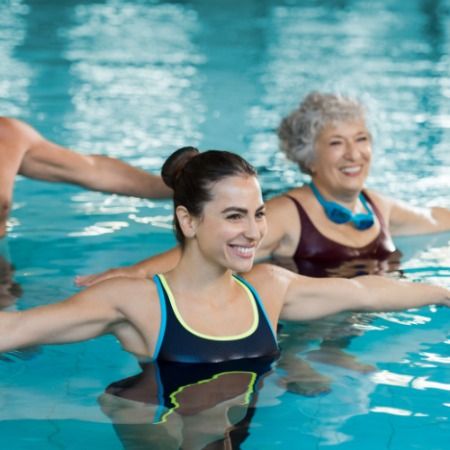
Improvement in balance is caused by the ability to make movement errors and correct for them and the water provides an environment in which this can be attempted safely. Hypothesized benefits are improved balance and improved sensory awareness.
Hypothesis: Patients may be challenged beyond limits of stability in the water without the fear of consequences of falling which are often present with land-based balance training. The environment leads to improvement in balance reactions which are translatable to land.
Building an Argument
I. Hydrodynamic principles
Movement through water is affected by turbulence and viscosity. Water is more viscous than air, and resistance to flow through water is greater than resistance to flow through air. Thus, it takes more force to push through water molecules than to push through air molecules. Additionally, the faster an object is pushed through the water, the more turbulence is created and this creates additional resistance to movement.
Richley Geigle et al argue that somatosensory input is increased more by moving an object through a viscous liquid than by moving through a less viscous gas (air). They postulate that resistance to movement may "cause distention or stretch of the skin resulting in stimulation of rapidly adapting mechanoreceptors, perhaps contributing to better proprioception."7 A body immersed is surrounded by a viscous fluid which retards the speed of movement. This viscosity prevents rapid falling and elongates the period of time in which a patient can respond to a shift of his center of mass outside his base of support. Additionally, the natural end result of a loss of balance which is not corrected is a fall into a compliant fluid (water) and not a fall to a noncompliant solid (the ground).
Thus, the patient may be challenged to move outside his base of support without fear of traumatic consequences. This reduction in patient anxiety may encourage the patient to attempt tasks which he would not attempt on land. It becomes possible to elicit balance challenges which the patient has both time and mental confidence to combat. On land, without the assistance of such aquatic properties, the resultant balance responses may be incomplete or absent. Water offers a three dimensional environment of both support and resistance. Any object with a specific gravity of less than one will tend to float toward the surface of the water. Alternatively, any object with a specific gravity less than one will sink.
According to Richley Geigle et al, these forces combine to "create multiple combinations of joint angles and planes of motion which are assisted, supported or resisted to various degrees. The therapist may use these combinations in the water to challenge the patient beyond his or her limit of stability, without the fear of the consequences of falling which are often present with land-based balance training."7
II. Clinical Research
Here is what five more studies and reviews found. We have stated plainly which ones measured balance and which did not.
- Medrado et al. (2022): a systematic review of 9 studies (604 people) with rheumatoid arthritis or spondyloarthritis. Aquatic exercise helped pain, disease activity and physical function. It did not report balance outcomes.1
- Pieniążek et al. (2021): a trial in 137 rehabilitation inpatients (not a rheumatology-only group). Four weeks of pool or gym therapy both improved balance on a force platform; the gain was slightly greater in the pool.2
- Zhao et al. (2020): a meta-analysis of 5 studies in ankylosing spondylitis. Aquatic therapy reduced pain and disease activity compared with controls. Balance was not a pooled outcome.3
- Faíl et al. (2022): a systematic review with meta-analysis of aquatic training in adults with and without chronic disease. Balance improved in healthy adults and in several conditions, including fibromyalgia and bone diseases.4
- Verhagen et al. (2012): a best-evidence synthesis in musculoskeletal conditions, including osteoarthritis, fibromyalgia and rheumatoid arthritis. Aquatic exercise reduced pain and disability with small to moderate effects. It did not focus on balance.5
Put together: aquatic exercise clearly helps pain and function in rheumatologic disorders, and balance gains are shown in some groups. Direct balance trials in rheumatology patients are still few.
Frequently asked questions
Why does aquatic training improve balance?
People get better at balance by making movement errors and correcting them, and the water allows that without danger (Aquatic Therapy University, 2024).
Do balance gains in water carry over to land?
Probably, but it is not proven. Carry-over to land is the hypothesis of this article [Expert opinion]; one small trial in older adults found functional reach improved after water exercise (Simmons and Hansen, 1996).
Why does water resist movement more than air?
Water is more viscous than air, so it resists flow and movement more (Aquatic Therapy University, 2024).
References
References
- Systematic reviewMedrado LN, Mendonça MLM, Budib MB, Oliveira-Junior SA, Martinez PF. Effectiveness of aquatic exercise in the treatment of inflammatory arthritis: systematic review. Rheumatol Int. 2022;42(10):1681-1691. doi:10.1007/s00296-022-05145-w. PubMed: 35633390.
- Pieniążek M, Mańko G, Spieszny M, et al. Body Balance and Physiotherapy in the Aquatic Environment and at a Gym. Biomed Res Int. 2021;2021:9925802. doi:10.1155/2021/9925802. PubMed: 34239934.
- Systematic review and meta-analysisZhao Q, Dong C, Liu Z, et al. The effectiveness of aquatic physical therapy intervention on disease activity and function of ankylosing spondylitis patients: a meta-analysis. Psychol Health Med. 2020;25(7):832-843. doi:10.1080/13548506.2019.1659984. PubMed: 31475583.
- Systematic review and meta-analysisFaíl LB, Marinho DA, Marques EA, et al. Benefits of aquatic exercise in adults with and without chronic disease-A systematic review with meta-analysis. Scand J Med Sci Sports. 2022;32(3):465-486. doi:10.1111/sms.14112. PubMed: 34913530.
- ReviewVerhagen AP, Cardoso JR, Bierma-Zeinstra SM. Aquatic exercise & balneotherapy in musculoskeletal conditions. Best Pract Res Clin Rheumatol. 2012;26(3):335-43. doi:10.1016/j.berh.2012.05.008. PubMed: 22867930.
- Randomized controlled trialSimmons V, Hansen PD. Effectiveness of water exercise on postural mobility in the well elderly: an experimental study on balance enhancement. J Gerontol A Biol Sci Med Sci. 1996;51(5):M233-8. doi:10.1093/gerona/51a.5.m233. PubMed: 8808995.
- Geigle PR, Cheek WL, Gould ML, Hunt HC, Shafiq B. Aquatic physical therapy for balance: the interaction of somatosensory and hydrodynamic principles. J Aquatic Phys Ther. 1997;5(1):4-10.
How to cite this article
First published May 6, 2024 on atuseminars.com · Last updated October 19, 2026 · Permanent URL: https://www.aquatictherapyuniversity.com/blog/balance-and-sensory-awareness-for-rheumatologic-disorders
How to cite
Aquatic Therapy University. (2024, May 6). Balance and Sensory Awareness for Rheumatologic Disorders. Aquatic Therapy University Blog. ATU Educational Services, LLC. https://www.aquatictherapyuniversity.com/blog/balance-and-sensory-awareness-for-rheumatologic-disorders
Permissions: You may quote and cite this article with attribution. Reproducing or adapting the full article requires written permission from ATU Educational Services, LLC.
For education only; not a substitute for individual clinical judgment.