
From The Deep End · ATU Blog
Balance training with a cognitive twist
Five reasons the pool suits balance training for people with Alzheimer's disease and cognitive impairment, with the supporting research.
First published March 18, 2024 on atuseminars.comPeople with Alzheimer’s disease are rarely the first ones referred to the pool. They should be on your list.
In water, a patient can be challenged past the limits of stability without the fall that would follow on land. Here are five reasons that matters.
Want to go deeper? Explore the Aquatic Therapy for Balance Disorders & Fall Risk course →
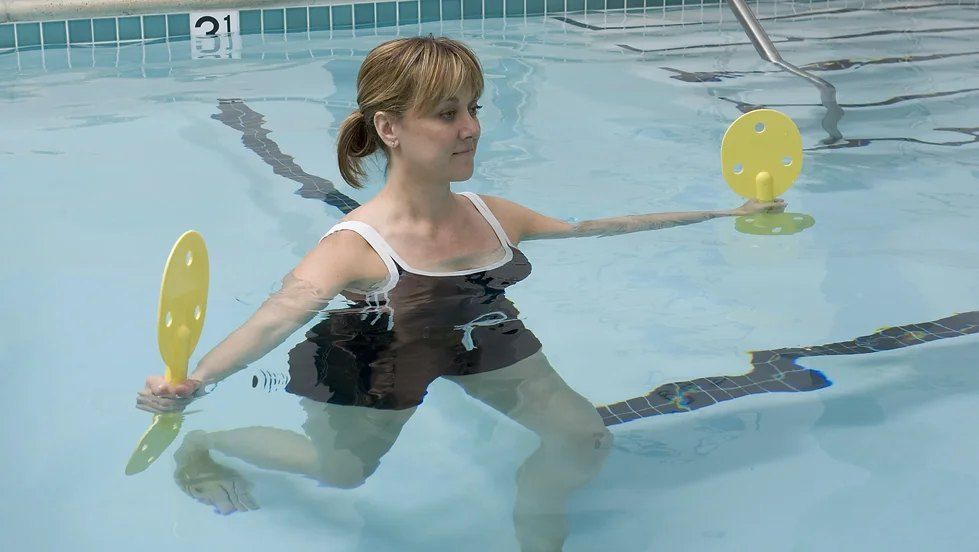
Why you should consider adding Alzheimer's patients to the list of aquatic therapy candidates. Read the research which supports this idea. Links located at end of post.
In the water, patients may be challenged beyond limits of stability without the fear of consequences of falling which are often present with land-based balance training. The environment leads to improvement in balance reactions which are translatable to land.
#1. Sensory and Motor Input. Movement through water is affected by turbulence and viscosity. Water is more viscous than air, and resistance to flow through water is greater than resistance to flow through air. Thus, it takes more force to push through water molecules than to push through air molecules. The faster an object is pushed through the water, the more turbulence is created and this creates additional resistance to movement. Additionally, the viscosity of water creates drag and this drag stimulates the sensory systems of the body.
#2. Reaction Time. A body immersed is surrounded by a viscous fluid which retards the speed of movement. This viscosity prevents rapid falling and elongates the period of time in which a patient can respond to a shift of his center of mass outside his base of support.
#3. Safety. In water, the natural end result of any loss of balance which is not corrected is a fall into a compliant fluid (water) and not a fall to a noncompliant solid (the ground). Thus, the patient may be challenged to move outside his base of support without fear of traumatic consequences. Which brings us to...
#4. Fear of Failure. This reduction in patient anxiety may encourage the patient to attempt tasks which he would not attempt on land. It becomes possible to elicit balance challenges which the patient has both time and mental confidence to combat. On land, without the assistance of such aquatic properties, the resultant balance responses may be incomplete or absent.
#5. Alertness and Arousal. A case report focused on how a nonambulatory patient with advanced Alzheimers made major gains in alertness and arousal after treatment with aquatic therapy using the Halliwick concept.1
Want some ideas on how to aquatic balance train... with a cognitive kick?
Supporting literature
Aquatic therapy and Alzheimer’s disease (case report, 2013)1
Aquatic therapy for residents with cognitive impairments (Provider magazine, 2010)
The physiological effects of aquatic exercise on cognitive function in the aging population (2013)2
Effects of two different exercise programs on gait parameters in individuals with Parkinson’s disease: a pilot study (2014)3
The effect of aquatic exercise on balance of adults with multiple sclerosis (2014)4
Effects of Ai-Chi on balance, functional mobility, strength and fatigue in patients with multiple sclerosis: a pilot study (2013)5
Effects of an aquatic therapy approach (Halliwick-Therapy) on functional mobility in subacute stroke patients: a randomized controlled trial (2014)6
What newer research says
- Dementia in residential care. In a trial of the Watermemories Swimming Club program, residents with advanced dementia who did aquatic exercise kept more of their muscle strength than those in usual care. Behavior and daily-living scores trended better but did not reach significance.7
- Mood and fear of falling. A 2021 systematic review found aquatic exercise improved mood, anxiety, fear of falling and mental quality of life in older adults, and studies in people with dementia showed fewer behavioral and psychological symptoms.8
The alertness finding comes from a single case report, so treat it as a promising lead, not proof.
Frequently asked questions
Why is the pool a good place for balance training?
Patients can be pushed past their limits of stability without the injury risk that a fall on land carries (Aquatic Therapy University, 2024).
Do balance gains in water transfer to land?
Yes. Better balance reactions developed in water can carry over to land (Aquatic Therapy University, 2024).
References
Supporting literature
The Provider magazine article (2010) is a trade article and is linked in the text only.
- Case reportMyers KW, Capek D, Shill H, Sabbagh M. Aquatic therapy and Alzheimer’s disease. Ann Long-Term Care. 2013;21(5):36-41.
- Sherlock L, Hornsby WG Jr, Rye J. Physiological effects of aquatic exercise on cognitive function in the aging population. Int J Aquatic Res Educ. 2013;7(3). doi:10.25035/ijare.07.03.09.
- Ayán C, Cancela JM, Gutiérrez-Santiago A, Prieto I. Effects of two different exercise programs on gait parameters in individuals with Parkinson's disease: a pilot study. Gait Posture. 2014;39(1):648-51. doi:10.1016/j.gaitpost.2013.08.019. PubMed: 24021522.
- Barbar A, Bahadoran R, Ghasemzadeh Y. The effect of aquatic exercise on balance of adults with multiple sclerosis. Eur J Exp Biol. 2014;4(1):38-43.
- Randomized controlled trialBayraktar D, Guclu-Gunduz A, Yazici G, et al. Effects of Ai-Chi on balance, functional mobility, strength and fatigue in patients with multiple sclerosis: a pilot study. NeuroRehabilitation. 2013;33(3):431-7. doi:10.3233/NRE-130974. PubMed: 23949074.
- Randomized controlled trialTripp F, Krakow K. Effects of an aquatic therapy approach (Halliwick-Therapy) on functional mobility in subacute stroke patients: a randomized controlled trial. Clin Rehabil. 2014;28(5):432-9. doi:10.1177/0269215513504942. PubMed: 24177711.
Newer research
- Randomized controlled trialHenwood T, Neville C, Baguley C, Beattie E. Aquatic exercise for residential aged care adults with dementia: benefits and barriers to participation. Int Psychogeriatr. 2017;29(9):1439-1449. doi:10.1017/S104161021700028X. PubMed: 28473006.
- Systematic reviewCampos DM, Ferreira DL, Gonçalves GH, Farche ACS, de Oliveira JC, Ansai JH. Effects of aquatic physical exercise on neuropsychological factors in older people: A systematic review. Arch Gerontol Geriatr. 2021;96:104435. doi:10.1016/j.archger.2021.104435. PubMed: 34030045.
How to cite this article
First published March 18, 2024 on atuseminars.com · Last updated October 19, 2026 · Permanent URL: https://www.aquatictherapyuniversity.com/blog/balance-training-with-a-cognitive-twist
How to cite
Aquatic Therapy University. (2024, March 18). Balance training with a cognitive twist. Aquatic Therapy University Blog. ATU Educational Services, LLC. https://www.aquatictherapyuniversity.com/blog/balance-training-with-a-cognitive-twist
Permissions: You may quote and cite this article with attribution. Reproducing or adapting the full article requires written permission from ATU Educational Services, LLC.
For education only; not a substitute for individual clinical judgment.