
From The Deep End · ATU Blog
Trust Falls
How the Aquatic Berg turns the 14 Berg Balance tasks into safe balance practice in the pool, with the depths, equipment and water temperature you need.
First published January 10, 2024 on atuseminars.comHere’s the paradox of fall prevention: the patients who most need to practice losing their balance are the ones who can least afford to fall. The pool gets you out of that bind.
In this post I explain how I turn the 14 tasks of the Berg Balance Test into balance training in the water, and what the research now says about it.
Want to go deeper? Explore the Aquatic Therapy for Balance Disorders & Fall Risk course →
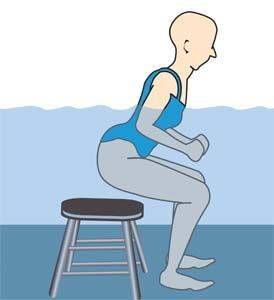
People recovering from falls can regain balance and confidence with the Aquatic Berg technique.
For many people, falls are a constant threat. And because of this looming concern, people rein in their movements.
They stop risking normal tasks such as climbing the stairs, or walking down a steep driveway, or picking up items off the floor. They are too afraid of the consequences to move without a walker or cane and probably should be.
Read the full article at Aquatics International or continue reading below.
Why the pool?
A severe fall on land can create a downward health spiral. A broken bone can lead to immobility, which can lead to pneumonia, which can even end in death. No wonder people are scared to move without their trusty, four-wheeled walker.
But for balance to improve, it must be challenged. People must be provided the opportunity to risk and to lose without fatal consequences. That's where your pool comes into play. In the pool, patients may be challenged beyond their limits of stability without the fear of consequences.
The research agrees that challenge is the active ingredient. A Cochrane review of 108 trials in older people living in the community found that programs built mainly on balance and functional exercises cut the rate of falls by about 24% (high-certainty evidence). Those programs were not pool-specific; the point is that balance improves when it is worked.1
What the Aquatic Berg is (and isn't)
To achieve this effect, I have adapted the Berg Balance Test2 into an aquatic balance training program. Obviously, the "Aquatic Berg" is not a specialty technique such as Watsu or the Halliwick Concept. It is not a new standardized aquatic test. We are not performing the test itself. It is just a clever way to harness the 14 different tests of balance into a training regime in the pool.
Therapists do not need extensive training sessions or certification programs to incorporate these task simulations into the water. However, the Aquatic Berg provides an excellent tool to help therapists challenge many of the different ways that people lose their balance.
Setting up: depths, equipment and water temperature
If you want to incorporate balance training into your therapy bag of tricks, it's best to have many different depths in your pool. You will need a depth shallow enough for your patients to sit on a bench or chair without trouble. You'll also need water that is shallow enough to enable patients to lean over and pick up items off the bottom of the pool. A depth of 3 feet or less is optimal for both these tasks; 2.5 feet is even better. You'll also need chest-deep water (4 feet to 5 feet) to perform tasks such as single limb standing.
Therapists will need certain items to perform permutations of the Berg in the pool. These include sinkable toys (such as dive sticks) to practice leaning over and picking up items; a chair (one with arms, one without) to practice transfers; an aquatic step to perform tapping of the foot; and a stopwatch or clock to time task completion. It's also helpful to have a colored stripe or contrasting tile line on the pool bottom to perform tightrope walking or tandem standing tasks.
Comfortable water temperatures (approximately 90 to 94 degrees Fahrenheit) are helpful for therapy because water that's too cool will chill patients during this non-aerobic session. However, any temperature above 85 degrees will work just fine. The environment should allow patients to hear the therapist without difficulty.
Who can use it, and how to tailor it
All health-care providers who perform balance training as part of their scope of practice may integrate aquatic proprioception drills, including the Berg, into their repertoires.
However, clinicians should be wary of cookie-cutter applications of the Berg elements in water. The water provides a powerful training medium, but balance drills should be tailored to address actual balance deficits. It is not enough to lazily follow the elements of the Berg by rote and hope to stumble upon a suitable proprioceptive challenge. The skilled clinician must experiment and determine which (if any) elements of the Berg create the best training application for each individual case.
… Continue reading Trust Falls at Aquatics International.
What the research says
Several systematic reviews have now looked at exercise in the water for balance in older adults.
- Compared with no exercise: a review of 15 trials (385 healthy adults aged 50 and over) found that aquatic therapy clearly improved dynamic balance compared with control groups. The authors call for larger, higher-quality trials.3
- Compared with land exercise: a review of 11 trials in adults 65 and over found that water and land exercise improved dynamic balance by similar amounts, so the pool is a reasonable alternative.4 A larger 2024 review (29 studies, 1,486 older adults) found bigger gains after water exercise on the Berg Balance Scale and the 30-second chair stand test, with no difference on the six-minute walk or Timed Up and Go.5 A 2023 review of healthy community-dwelling older adults also favored the water for balance, gait, quality of life and fear of falling, but rated the evidence as low quality.6
- Falls themselves: a review of 14 aquatic trials found that none reported fall rates; water exercise did improve risk factors for falling such as strength and balance.7 A 2025 review comparing the Otago Exercise Program with aquatic exercise concluded that both are safe and help prevent falls, with aquatic exercise slightly ahead on balance-related abilities such as gait stability.8
In short, the evidence supports the pool as a safe place to challenge balance. Whether pool programs on their own cut the number of falls has not yet been tested well.
The bottom line: let your patients practice losing their balance in the one place where losing it doesn’t mean hitting the floor.
Frequently asked questions
Why is the pool a good place to challenge balance?
Because patients can lose their balance in the water and recover without the consequences of a fall on land (Salzman, 2024).
Who can use aquatic balance drills such as the Aquatic Berg?
Any health-care provider whose scope of practice includes balance training can add these drills; no certification is required (Salzman, 2024).
Can a fall on land start a downward health spiral?
Yes. A broken bone can lead to immobility, then pneumonia and, in some cases, death (Salzman, 2024).
References
Cited in the post
- Systematic review and meta-analysisSherrington C, Fairhall NJ, Wallbank GK, et al. Exercise for preventing falls in older people living in the community. Cochrane Database Syst Rev. 2019;1(1):CD012424. doi:10.1002/14651858.CD012424.pub2. PubMed: 30703272.
- Validation studyBerg KO, Wood-Dauphinee SL, Williams JI, Maki B. Measuring balance in the elderly: validation of an instrument. Can J Public Health. 1992;83 Suppl 2:S7-11. PubMed: 1468055.
Research on aquatic balance training (What the research says)
- Systematic review and meta-analysisShariat A, Ghayour Najafabadi M, Ghannadi S, et al. Effects of aquatic therapy on balance in older adults: a systematic review and meta-analysis. Eur Geriatr Med. 2022;13(2):381-393. doi:10.1007/s41999-021-00577-2. PubMed: 34817841.
- Systematic review and meta-analysisKim Y, Vakula MN, Waller B, Bressel E. A systematic review and meta-analysis comparing the effect of aquatic and land exercise on dynamic balance in older adults. BMC Geriatr. 2020;20(1):302. doi:10.1186/s12877-020-01702-9. PubMed: 32842967.
- Systematic review and meta-analysisDeng Y, Tang Z, Yang Z, et al. Comparing the effects of aquatic-based exercise and land-based exercise on balance in older adults: a systematic review and meta-analysis. Eur Rev Aging Phys Act. 2024;21(1):13. doi:10.1186/s11556-024-00349-4. PubMed: 38764039.
- Systematic review and meta-analysisMelo RS, Cardeira CSF, Rezende DSA, Guimarães-do-Carmo VJ, Lemos A, de Moura-Filho AG. Effectiveness of the aquatic physical therapy exercises to improve balance, gait, quality of life and reduce fall-related outcomes in healthy community-dwelling older adults: A systematic review and meta-analysis. PLoS One. 2023;18(9):e0291193. doi:10.1371/journal.pone.0291193. PubMed: 37683025.
- Systematic reviewMartínez-Carbonell Guillamón E, Burgess L, Immins T, Martínez-Almagro Andreo A, Wainwright TW. Does aquatic exercise improve commonly reported predisposing risk factors to falls within the elderly? A systematic review. BMC Geriatr. 2019;19(1):52. doi:10.1186/s12877-019-1065-7. PubMed: 30795740.
- Systematic reviewDong M, Liu X, Choi Y, Li N. Effects of Otago Exercise Program and aquatic exercise on fall risk in older adults: A systematic review. Arch Gerontol Geriatr. 2025;132:105799. doi:10.1016/j.archger.2025.105799. PubMed: 40037071.
How to cite this article
First published January 10, 2024 on atuseminars.com · Last updated October 19, 2026 · Permanent URL: https://www.aquatictherapyuniversity.com/blog/trust-falls
How to cite
Salzman, A. (2024, January 10). Trust Falls. Aquatic Therapy University Blog. ATU Educational Services, LLC. https://www.aquatictherapyuniversity.com/blog/trust-falls
Permissions: You may quote and cite this article with attribution. Reproducing or adapting the full article requires written permission from ATU Educational Services, LLC.
For education only; not a substitute for individual clinical judgment.