
From The Deep End · ATU Blog
Part 1 of 2Aquatic Therapy: Procedure or Profession? (Part 1 of 2)
Part 1: what aquatic therapy is, how it differs from adapted aquatics and aquatic fitness, and why it is a procedure rather than a profession.
First published November 18, 2023 on atuseminars.comWho is allowed to do aquatic therapy? To answer that, we first have to define what aquatic therapy is. Part 1 starts there.
Want to go deeper? Explore the Documentation & Billing for Aquatic Therapy Practice course →
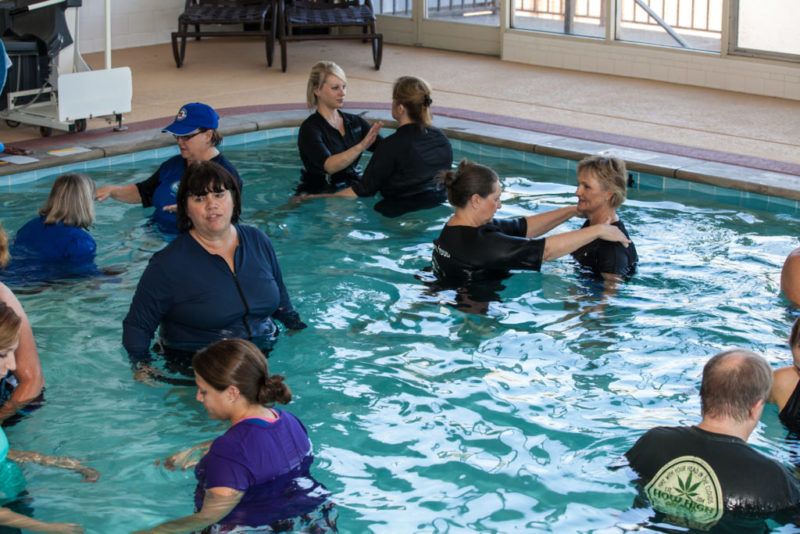
©2023, Originally posted by ATU on www.aquaticnet.com/qualifications.htm
What is aquatic therapy and who can perform it? What qualifications must one must have to consider themselves able to practice aquatic therapy? Does one need to have a degree in physical therapy? Or is there a specific aquatic rehabilitation program of study that leads to a degree and/or certificate that would suffice?
In the future, each state attorney general may be asked to render an opinion about this matter (much as they have done with joint manipulation). There may even eventually be state legislation which restricts the use of the term "aquatic therapy" or "aquatic therapist". But for now, in the absence of a prevailing legal authority on this matter, confusion reigns. So let's work through the question logically.
Point #1. To determine who can perform aquatic therapy, we must define what "aquatic therapy" is.
Definition of Aquatic Therapy: A therapeutic procedure which attempts to improve function through the application of aquatic therapeutic exercises. These procedures require constant attendance of a therapist educated in performing aquatic therapeutic exercises. [1,2] Common synonyms: Aquatic Rehabilitation, Aqua Therapy, Pool Therapy, Water Therapy, Hydrotherapy (outside the USA). |
First, notice that aquatic therapy is considered a therapeutic procedure, not a modality. There are many technical and practical distinctions between the practice of aquatic therapy and the application of therapeutic modalities.
Definition of Therapeutic Modality: Any physical agent applied to produce therapeutic changes to biologic tissue; including but not limited to, thermal, acoustic, light, mechanical, or electrical energy. Whirlpool for wound care, or hydrotherapy, is considered a modality by the American Medical Association (AMA). [1] Definition of Therapeutic Procedure: A manner of effecting change through the application of clinical skills and/or services that attempt to improve function. The physician or therapist is required to have direct (one-on-one) patient contact. A procedure typically requires patient participation. [1] |
It undeniable that water has been used throughout our history as a modality to elicit the passive transmission of heat, cold, chemicals, friction, pressure or a combination of the same by immersing the body or body part. It is, however, an important distinction to describe the difference between the use of water as a passive modality and the use of water for an active procedure. The term aquatic therapy should be reserved for the latter as is evident by the manner in which the AMA has chosen to define it. [1,2]
Second, note that it is necessary to distinguish the term "aquatic therapy" from the terms "adapted aquatics" and "aquatic fitness".
Definition of Adapted Aquatics: A learn-to-swim program for individuals with disabilities. [3] Definition of Aquatic Fitness: A mode of aquatic exercise that is distinctively not swimming and not therapeutic exercise, but which is performed in a face-out, vertical position in various depths of water with the intent to improve physical and/or mental health. [4,5]. |
Neither adapted aquatics nor aquatic fitness are considered therapeutic procedures (or modalities) by the American Medical Association.
Third, note that aquatic therapy, as defined by the AMA, is not "tied" to a single profession. It can arguably be performed by several legally-regulated healthcare providers who have scopes of practice which permit them to perform such services (see point #2) and who are permitted to use the AMA's Current Procedural Codes (CPT).
However, all healthcare providers who can legally perform aquatic therapy are not permitted to perform every intervention which is included under the umbrella term "aquatic therapy". In other words, providers must operate under same limitations to scope of practice as they operate under on land. By entering the pool, all scopes of practice do not become equal.
Example: Physical therapists' scopes of practice do not include breath control for speech enunciation, so when/if a physical therapist works in the water, his practice of aquatic therapy cannot include the practice of speech therapy even if such an act seems a natural extension of his work.
Example: Massage therapists' scopes of practice are comprised of massage/bodywork and some adjunctive modalities, so when/if a massage therapist works in the water, his practice of aquatic therapy can be comprised of those services (the exact definition of what these acts entail is left to the definition found in each state's practice act). His scope of practice does not permit him to perform aquatic therapeutic exercise or joint mobilization or other interventions which are not included as part and parcel of his practice. This remains true even if the massage therapist has received continuing educational training in which he has learned to perform such acts.
Example: Kinesiotherapists' scopes of practice are comprised of therapeutic exercise and education, so when/if a kinesiotherapist works in the water, his practice of aquatic therapy can be comprised of therapeutic exercise and education. He cannot perform acts or services not covered by his scope of practice, such as massage or other manual therapies.
Lastly, it is important to note that not all professions are legally permitted to work with all patients at all times. In some states, massage therapists are restricted to working with "apparently healthy" individuals and cannot see clients for "therapeutic" interventions.
According to the American Kinesiotherapy Association, kinesiotherapists may only work with medically stable individuals in post-acute rehab settings.
Clinical exercise physiologists (in Louisiana, for example) can only "formulate, develop and implement exercise protocols and programs, administer graded exercise tests, and provide education regarding such exercise programs and tests in a cardiopulmonary rehabilitation program [under the direction, approval and supervision of a licensed physician]....".
In some states, athletic trainers cannot work with individuals who are not team athletes (as traditionally defined). Whatever limitations each healthcare provider has on land must be upheld once he enters the pool.
Conclusion: The term "aquatic therapy" is an umbrella term; it is used as a convenience to describe many 1:1 therapeutic procedures which occur in the water. However, the exact nature of those acts and services differ for each profession which takes its patients into an aquatic setting. All things do not "become equal" once in water. All therapeutic interventions do not become fair game to all providers.
Continued in Part 2. Read Part 2.
Frequently asked questions
How do you determine who can perform aquatic therapy?
Start by defining what aquatic therapy is (Salzman, 2023).
Can every provider perform every aquatic therapy intervention?
No. Even providers who may legally perform aquatic therapy can only use the interventions within their own scope of practice (Salzman, 2023).
Could states restrict the term "aquatic therapist"?
Possibly. Future state laws may limit who can use the terms (Salzman, 2023).
References
- Brokaw, M. M. (2022). Aquatic therapy: An interprofessional resource focusing on children with developmental and intellectual disabilities.
- Hoogenboom, B. J., & Lomax, N. E. (2024). Aquatic therapy in rehabilitation. In Rehabilitation techniques for sports medicine and athletic training (pp. 379-404). Routledge.
- Young, S., & Collins, T. (2022). Factors influencing the use of aquatic therapy: perspectives from occupational therapists. International Journal of Therapy and Rehabilitation, 29(9), 1-12.
- American Medical Association. Current Procedural Terminology (CPT), 4th ed. American Medical Association; Chicago, IL; 1999: 415-416.
- CPT Information Services. Personal communication clarifying CPT definition of aquatic therapy. American Medical Association: Chicago, IL; April 8, 1999.
- American Alliance for Health, Physical Education, Recreation and Dance, Association for Active Lifestyles and Fitness, Aquatic Council. Adapted Aquatics Instructional Credentialing Program. American Alliance for Health, Physical Education, Recreation and Dance: Reston, VA; 1999.
- Elder T, Campbell K. Aquatic Fitness Everyone, 2nd ed. Winston-Salem, NC: Hunter Textbooks Inc; 1997.
- Aquatic Exercise Association. What is aquatic fitness? Water Well. 1999; Vol. 6.
- Definition of "certification": A document certifying (authenticating or vouching in writing) that one has fulfilled the requirements of and may practice in a field. Black HC. Black's Law Dictionary, 6th ed. Publisher's Editorial Staff: St. Paul, MN; 1990.
References
DisclaimerThe information presented in this article is meant to be a summary and educational in nature. It is not meant to serve as a substitute for legal advice.
Author Bio
Andrea Poteat Salzman, MS, PT is the owner of two businesses, the Aquatic Resources Network and Concepts in Physical Therapy. She has received both the prestiguous Aquatic Therapy Professional of the Year Award (Aquatic Therapy and Rehabilitation Institute) and the Tsunami Aquatic Therapy Award.
Salzman is well-regarded within the industry as:
Editor-in-Chief of an aquatic therapy trade journal and newsletter;
Author of over a dozen publications, including the soon-to-be-released Evidence-Based Aquatic Therapy textbook;
Freelance author and columnist;
Aquatic therapy seminar instructor;
Adjunct faculty and research advisor, St. Catherine Physical Therapy Program, Minneapolis, MN;
Immediate past manager of therapeutic aquatics, St. Paul Ramsey Medical Center, St. Paul, MN;
Researcher and grant recipient examining aquatic exercise vs. land-based exercise.
She may be reached via e-mail at asalzman@aquaticnet.com
How to cite this article
First published November 18, 2023 on atuseminars.com · Last updated October 19, 2026 · Permanent URL: https://www.aquatictherapyuniversity.com/blog/aquatic-therapy-procedure-or-profession-part-1
How to cite
Salzman, A. (2023, November 18). Aquatic Therapy: Procedure or Profession? (Part 1 of 2). Aquatic Therapy University Blog. ATU Educational Services, LLC. https://www.aquatictherapyuniversity.com/blog/aquatic-therapy-procedure-or-profession-part-1
Permissions: You may quote and cite this article with attribution. Reproducing or adapting the full article requires written permission from ATU Educational Services, LLC.
For education only; not a substitute for individual clinical judgment.