
From The Deep End · ATU Blog
Part 1 of 2Ai Chi: Safety and Effectiveness (Part 1 of 2)
Part 1: what Ai Chi is, how its movements progress, how Clinical Ai Chi differs, and how it can be used to train balance and prevent falls in older adults.
First published May 13, 2024 on atuseminars.comAi Chi looks almost too gentle to count as training. That is the point: it lets frail people work on balance in water that catches them.
Part 1 covers what it is, how the movements progress, and how to use it for fall prevention.
Want to go deeper? Explore the Aquatic Therapy for Balance Disorders & Fall Risk course →
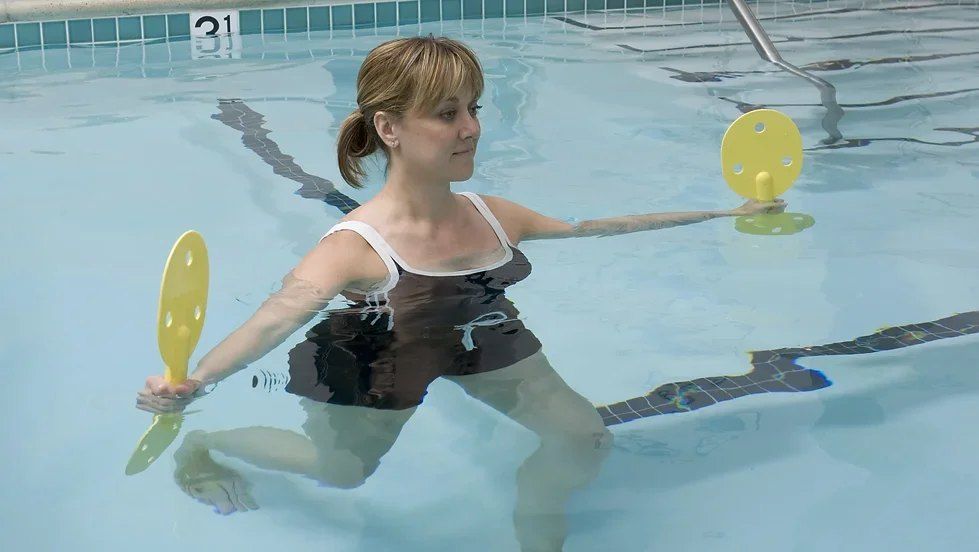
Ai Chi is a type of relaxing aquatic exercises, which utilizes modified Tai Chi movements. 6 There is a great deal of medical information to support the health benefits of Tai Chi, which include fall prevention and the alleviation of musculoskeletal pain. 1,2,3,4,5
The aquatic environment of Ai Chi lowers physical stress while performing modified Tai Chi movements. Therefore, Ai Chi is especially suited for frail individuals, who are looking to reap the benefits of land-based Tai Chi. Through Ai chi, a participant makes slow gradual movements in a relaxed manner, modifying each component of movement with greater stabilization. The participant is encouraged to balance his/her body weight while performing the Ai Chi movements in water.
In the words of Ruth Sova, “The client should concentrate on working with balance and precision, not tightness and stress.” Circular Ai Chi movements involve more muscle and joint mobility functions than the linear movements.
Ai Chi utilizes diaphragmatic breathing. 6 This type of breathing stimulates the parasympathetic system, leading to reduced blood pressure and heart rate. Another health benefit of diaphragmatic breathing is improved lymphatic flow, which may in turn help prevent infections. Diaphragmatic breathing draws air to the deepest parts of the lungs, wherein oxygen exchange can occur most efficiently.
During Ai Chi exhalation is carried out through the mouth and inhalation through the nose.
Ai Chi uses trunk movements in the thoracic-lumbar area; and this might inhibit sympathetic activity, leading to a calming down effect. 7 Ai Chi is a relaxing experience that help mobilize connective tissues around joints, muscles and the nervous system. 7 [Expert opinion] The slow, repetitive movements along with muscle elongation activities of Ai Chi can benefit the viscoelastic properties of connective tissues.
Ai Chi movements are presented with increasing difficulties as a participant’s skills develop. With practice, a participant can perform these movements consistently without much physical / cognitive effort.
The postural Ai Chi movements are briefly outlined below:
Contemplating, Floating, Uplifting, Enclosing and Folding
Soothing
Gathering
Freeing
Shifting
Accepting
Accepting with Grace and Rounding
Balancing
Half Circling, Encircling, Surrounding, Nurturing
Flowing and Reflecting
Suspending 7 [Expert opinion]
The above sequence is based on increasing difficulty of regulatory control for the Ai Chi participant. The participant moves from a symmetrical trunk position to rotating trunk movements, from a static center of gravity (COG) to a dynamic COG, from small to large hand movements, from a wide base support to narrow support bases, from visual control to non-visual / vestibular control, and finally from symmetrical to asymmetrical arm movements. 7 [Expert opinion]
Variations: Ai Chi is performed in shoulder-deep thermoneutral water. The participant stands with knees slightly flexed. “Wall Ai Chi” is Ai chi performed while holding onto a bar for support. This may be useful for participants who are fearful of falling / losing balance. Participants may pair up and perform Ai Chi movements together; this group activity is called “Ai Chi Ne.”
Some individuals, who are unable to stand, may sit on a stool in shallow water while performing Ai Chi. This technique may benefit participants with conditions, such as leg paralysis and lower back pain.
“Clinical Ai Chi,” unlike Ai Chi performed in healthy individuals, is applied to people with disabilities or therapeutic conditions. Clinical Ai Chi involves multiple subcategories of both function and activity, 7 as defined by the International Classification of Functioning, Disability and Health (ICF). 8 [Expert opinion] Clinical Ai Chi supports numerous neuromusculoskeletal and movement functions, such as mobility of joints and bones, stability of joints, muscle power, involuntary movement reactions, coordination of voluntary movements, leg supportive functions and muscle stiffness and spasms. In addition, Clinical Ai Chi enhances a participant’s mobility, through activities, such as shifting the body’s center of gravity, maintaining a standing position and arm movements.
This article describes medical information to support the health benefits of Ai Chi in several target populations.
Fall prevention: Falls in the elderly population is a leading cause of injury-related hospitalization. The aquatic medium can be used for elderly individuals to provide training on balance. Numerous studies have shown the benefit of aquatic therapy on elderly individuals with balance and coordination difficulties. 9,10,11,12,18
Lambeck and Bommer 7 [Expert opinion] suggest several Ai Chi movements that can specifically be used for training elderly individuals in balance and posture control. Listed below are key points of consideration, from their clinical teaching [Expert opinion]:
Ai Chi movements that involve changes in the center of mass, minimal support of upper extremities and balancing on a narrow base, may be encouraged.
A typical therapy regimen should incorporate at least 50 hours of exercise.
If desired, Ai Chi can be made more challenging by removing some of the static and stable movements from the program.
Ai chi can be designed to facilitate lateral stability and lateral stepping skills. These skills are encouraged while working in tandem and unipedal positions with asymmetric hand movements. Again, cross-step movements without pivots can be used for developing lateral stability. Finally, side-stepping movements without foot crossing can also encourage the same.
Long arm reaching movements help develop balance and stability. The range of arm movements can be explored, and the participant may be encouraged to hold the pose for few seconds to challenge a posture.
Limited knee and plantar flexions may be observed in the elderly population. This leads to difficulty stepping over an obstacle. Ai Chi anterior weight shift encourages knee and plantar flexion movements. This activity starts with plantar flexion of the hind limb ankle, and subsequently the swing leg is moved along with knee flexion.
In the elderly population, gait variability is reduced as a result of the decreased rotation of the spinal joints. During Ai Chi, participants may be encouraged to focus on rotations between the pelvis and thorax, and continue rotations till the end of the active range of motion. Following the hand movements with the eye may also be encouraged to facilitate cervical spine rotation.
Hip movements and balance are facilitated by Ai Chi. For example, hip extension and flexion could be encouraged during Ai Chi, along with lateral hip movements for the tandem stance or unipedal movements.
Ai Chi movements should be slow. The reduced pace of these movements encourage connective tissue mobility and also decrease musculotendinous stiffness.
The slow Ai Chi movement of Uplifting or abduction leads to muscular activation at a reduced intensity as compared with rapid movements as well as those performed on land. 13 Therefore, Ai Chi may be used for early active motion following shoulder injury or surgery.
Continued in Part 2. Read Part 2.
What newer research says
- Stroke, 2021 meta-analysis. Across 28 randomized trials (961 people), aquatic therapy beat land-based therapy for balance and walking, and established methods such as Halliwick and Ai Chi did best. The authors still judged the evidence insufficient for firm recommendations.23
- Ai Chi and balance after brain injury, 2021 trial. 45 people more than a year after brain injury did 12 weeks of land therapy, Ai Chi, or both. The combined group improved most on balance tests; the Ai Chi group also improved.24
Most Ai Chi trials are small, and none yet tests the 50-hour figure.
Frequently asked questions
What is Ai Chi?
A gentle aquatic exercise built on modified Tai Chi movements, with a good deal of medical evidence behind Tai Chi's health benefits (Aquatic Therapy University, 2024).
Who is Ai Chi especially suited for?
Frail people who want the benefits of Tai Chi without the stress of doing it on land (Aquatic Therapy University, 2024).
What kind of breathing does Ai Chi use?
Diaphragmatic breathing, which stimulates the parasympathetic system and can lower blood pressure and heart rate (Aquatic Therapy University, 2024).
References
References (shared with Part 2)
- Randomized controlled trialFransen M, Nairn L, Winstanley J, Lam P, Edmonds J. Physical activity for osteoarthritis management: a randomized controlled clinical trial evaluating hydrotherapy or Tai Chi classes. Arthritis Rheum. 2007;57(3):407-14. doi:10.1002/art.22621. PubMed: 17443749.
- Systematic review and meta-analysisGillespie LD, Robertson MC, Gillespie WJ, et al. Interventions for preventing falls in older people living in the community. Cochrane Database Syst Rev. 2012;2012(9):CD007146. doi:10.1002/14651858.CD007146.pub3. PubMed: 22972103.
- Gregory H, Watson MC. The effectiveness of Tai Chi as a fall prevention intervention for older adults: a systematic review. Int J Health Promot Educ. 2009;47(3):94-100. doi:10.1080/14635240.2009.10708166.
- Systematic review and meta-analysisHall A, Maher C, Latimer J, Ferreira M. The effectiveness of Tai Chi for chronic musculoskeletal pain conditions: a systematic review and meta-analysis. Arthritis Rheum. 2009;61(6):717-24. doi:10.1002/art.24515. PubMed: 19479696.
- Harling A, Simpson JP. A systematic review to determine the effectiveness of Tai Chi in reducing falls and fear of falling in older adults. Phys Ther Rev. 2008;13(4):237-248. doi:10.1179/174328808x309241.
- Book chapterSova R. Ai Chi. In: Brody LT, Geigle PR, eds. Aquatic Exercise for Rehabilitation and Training. Champaign, IL: Human Kinetics; 2009:101-116.
- Book chapterLambeck J, Bommer A. Ai Chi: applications in clinical practice (Clinical Ai Chi). In: Becker BE, Cole AJ, eds. Comprehensive Aquatic Therapy. 3rd ed. Pullman, WA: Washington State University Publishing; 2011:171-191. Chapter at EWAC Medical.
- ClassificationWorld Health Organization. International Classification of Functioning, Disability and Health (ICF). Geneva: WHO; 2001. who.int.
- Arnold CM, Busch AJ, Schachter CL, Harrison EL, Olszynski WP. A Randomized Clinical Trial of Aquatic versus Land Exercise to Improve Balance, Function, and Quality of Life in Older Women with Osteoporosis. Physiother Can. 2008;60(4):296-306. doi:10.3138/physio.60.4.296. PubMed: 20145763.
- Randomized controlled trialLund H, Weile U, Christensen R, et al. A randomized controlled trial of aquatic and land-based exercise in patients with knee osteoarthritis. J Rehabil Med. 2008;40(2):137-44. doi:10.2340/16501977-0134. PubMed: 18509579.
- Randomized controlled trialSuomi R, Koceja DM. Postural sway characteristics in women with lower extremity arthritis before and after an aquatic exercise intervention. Arch Phys Med Rehabil. 2000;81(6):780-5. doi:10.1016/s0003-9993(00)90111-4. PubMed: 10857524.
- Randomized controlled trialTomas-Carus P, Häkkinen A, Gusi N, Leal A, Häkkinen K, Ortega-Alonso A. Aquatic training and detraining on fitness and quality of life in fibromyalgia. Med Sci Sports Exerc. 2007;39(7):1044-50. doi:10.1249/01.mss.0b0138059aec4. PubMed: 17596770.
- Kelly BT, Roskin LA, Kirkendall DT, Speer KP. Shoulder muscle activation during aquatic and dry land exercises in nonimpaired subjects. J Orthop Sports Phys Ther. 2000;30(4):204-10. doi:10.2519/jospt.2000.30.4.204. PubMed: 10778797.
- Randomized controlled trialDevereux K, Robertson D, Briffa NK. Effects of a water-based program on women 65 years and over: a randomised controlled trial. Aust J Physiother. 2005;51(2):102-8. doi:10.1016/s0004-9514(05)70038-6. PubMed: 15924512.
- Conference abstractTeixeira R, Neto F, Perez L. The influence of Ai Chi on balance and fear of falling among older adults [abstract]. In: Carral JMC, Cao AR, Martinez SV, eds. Physical Activity, Health Promotion and Aging: Book of Abstracts, 11th International Conference EGREPA. Pontevedra; 2007:320. Dialnet record.
- BookSova R, Konno J. Ai Chi: Balance, Harmony & Healing. 2nd ed. Port Washington, WI: DSL Ltd; 2003.
- Randomized controlled trialPérez de la Cruz S. Effectiveness of aquatic therapy for the control of pain and increased functionality in people with Parkinson's disease: a randomized clinical trial. Eur J Phys Rehabil Med. 2017;53(6):825-832. doi:10.23736/S1973-9087.17.04647-0. PubMed: 28627861.
- Randomized controlled trialNoh DK, Lim JY, Shin HI, Paik NJ. The effect of aquatic therapy on postural balance and muscle strength in stroke survivors--a randomized controlled pilot trial. Clin Rehabil. 2008;22(10-11):966-76. doi:10.1177/0269215508091434. PubMed: 18955428.
- Castro-Sánchez AM, Matarán-Peñarrocha GA, Lara-Palomo I, Saavedra-Hernández M, Arroyo-Morales M, Moreno-Lorenzo C. Hydrotherapy for the treatment of pain in people with multiple sclerosis: a randomized controlled trial. Evid Based Complement Alternat Med. 2012;2012:473963. doi:10.1155/2012/473963. PubMed: 21785645.
- Randomized controlled trialBayraktar D, Guclu-Gunduz A, Yazici G, et al. Effects of Ai-Chi on balance, functional mobility, strength and fatigue in patients with multiple sclerosis: a pilot study. NeuroRehabilitation. 2013;33(3):431-7. doi:10.3233/NRE-130974. PubMed: 23949074.
- Randomized controlled trialCalandre EP, Rodriguez-Claro ML, Rico-Villademoros F, Vilchez JS, Hidalgo J, Delgado-Rodriguez A. Effects of pool-based exercise in fibromyalgia symptomatology and sleep quality: a prospective randomised comparison between stretching and Ai Chi. Clin Exp Rheumatol. 2009;27(5 Suppl 56):S21-8. PubMed: 20074435.
- Kelley C, Loy DP. Comparing the effects of aquatic and land-based exercise on the physiological stress response of women with fibromyalgia. Ther Recreation J. 2008;42(2):103-118. Journal page.
Newer research
- Systematic review and meta-analysisVeldema J, Jansen P. Aquatic therapy in stroke rehabilitation: systematic review and meta-analysis. Acta Neurol Scand. 2021;143(3):221-241. doi:10.1111/ane.13371. PubMed: 33141446.
- Randomized controlled trialPérez-de la Cruz S. Comparison between Three Therapeutic Options for the Treatment of Balance and Gait in Stroke: A Randomized Controlled Trial. Int J Environ Res Public Health. 2021;18(2):426. doi:10.3390/ijerph18020426. PubMed: 33430476.
How to cite this article
First published May 13, 2024 on atuseminars.com · Last updated October 19, 2026 · Permanent URL: https://www.aquatictherapyuniversity.com/blog/ai-chi-safety-and-effectiveness-part-1
How to cite
Aquatic Therapy University. (2024, May 13). Ai Chi: Safety and Effectiveness (Part 1 of 2). Aquatic Therapy University Blog. ATU Educational Services, LLC. https://www.aquatictherapyuniversity.com/blog/ai-chi-safety-and-effectiveness-part-1
Permissions: You may quote and cite this article with attribution. Reproducing or adapting the full article requires written permission from ATU Educational Services, LLC.
For education only; not a substitute for individual clinical judgment.