
From the Deep End · ATU Blog
The Bad Ragaz Ring Method (BRRM)
The history of the Bad Ragaz Ring Method from 1950s Wildbad to today, the questions it left open, and a close look at one bilateral leg pattern.
First published February 17, 2025 on atuseminars.com Guest editorial. © 2025 Johan Lambeck. Submitted by the author for publication by ATU Educational Services, LLC.Johan Lambeck learned the Bad Ragaz Ring Method in 1993 and has taught it alongside Halliwick and Water Specific Therapy. This guest post is the first in his short series on the method, starting with its history and one leg pattern.
Want to go deeper? Explore the Aquatic Therapy Essentials (Bootcamp) bundle →
In a small series of blogs about the BRRM, I will describe characteristics, starting with a summary of the history and afterwards a technical description of a pattern.
History
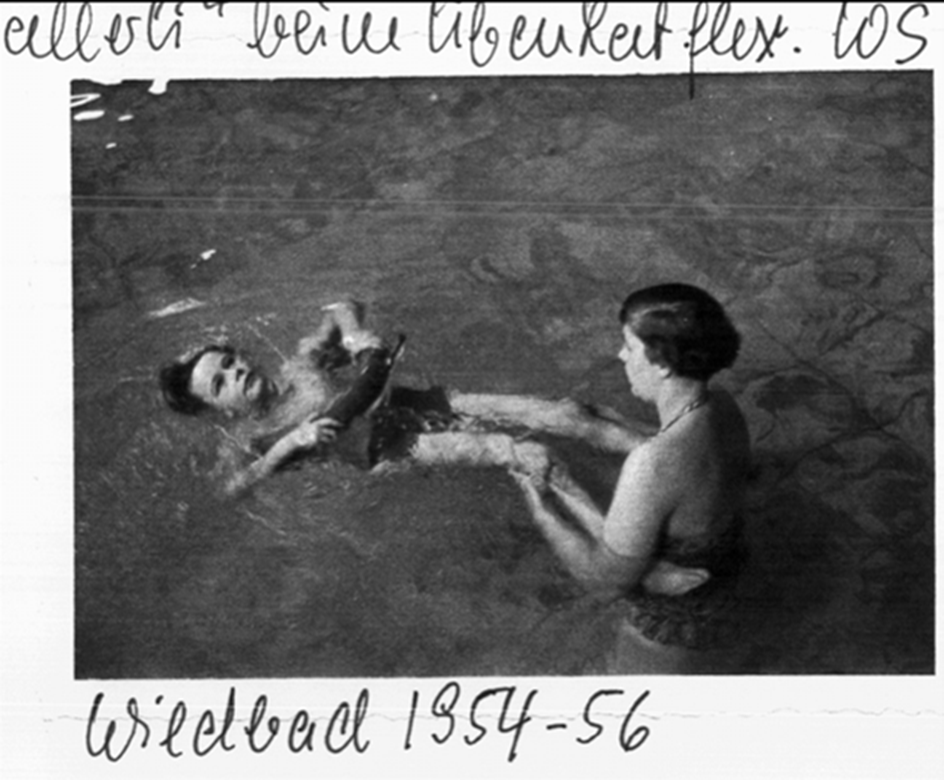
It all began in the Orthopedic Clinic “Werneheim” in the German city of Wildbad. The physiotherapist Anneliese tum Suden worked there and described in an article in the German Physiotherapy Journal (Krankengymnastik) in 1955 about the functional treatment of poliomyelitis. In this article she mentioned that clients were supported by floats to freely move through water, while using resistance of the hands of the therapist. This became the “Wildbader Methode mit Ringen”: initially a way to use resistance of water, using movements in single plane muscular chains. This method was theoretically founded a few years before by their orthopedic surgeon in charge, Dr. H. Knupfer.
This method was introduced in the Medical Center Bad Ragaz (Switzerland) in 1957. Therapists coming back from PNF courses in Vallejo, introduced some principles to the original ring method. The first publication about this “Bad Ragaz Method” was in 1967 by Bridget Davis in the English journal “Physiotherapy”. This method turned out to be quite strenuous for the therapist, which led to a project to decrease work for the therapist and increase work for the client. The project also focused on inclusion of the Swiss method Functional Kinetics and (aquatic) biomechanics.
The leading therapist in this project was Beatrice Egger supported by e.g. Urs Gamper, managed by James McMillan and Dr. W. Zinn, the medical doctor in charge. The first written information about this “New Ragaz Method with Rings” was in 1974. The photo comes from the slide series belonging to German publication ‘Aktive Physiotherapie im Wasser, Band 1: Neue Ragazer Methode mit Ringen (1990) by Beatrice Egger and Wilhelm M. Zinn. Gustav Fischer Verlag, Stuttgart.
The author (JL) learned the BRRM in a course in Bath (UK) in 1993 and when meeting Beatrice Egger what he started teaching Halliwick courses in the educational center “Hermitage” Bad Ragaz after McMillan passed away in 1994. The Hermitage decided in 2000 to add BRRM to the existing Halliwick, which was extended to Water Specific Therapy in the meantime. Urs Gamper started to teach BRRM and joined forces with Johan Lambeck. This resulted in the publication of a CD in 2003. The cooperation also led to ongoing discussions with questions why till then:
- no EMG measurements were available
- only client-maximal isotonic and isometric strength was trained
- no low-level fine tuning or eccentric contractions were considered
- power and local endurance were not addressed
- knowledge about effects on intra- and extramuscular fascia wasn’t included
- spasticity was considered to be a contra-indication
- proprioceptive/discriminative feedback wasn’t considered when discussing pain syndromes
- PNF techniques had not been included
-rules from exercise physiology had not been included, e.g. working at various percentages of the 1 repetition maximum
- the role of priming of functional movement (in the pool) had not been mentioned
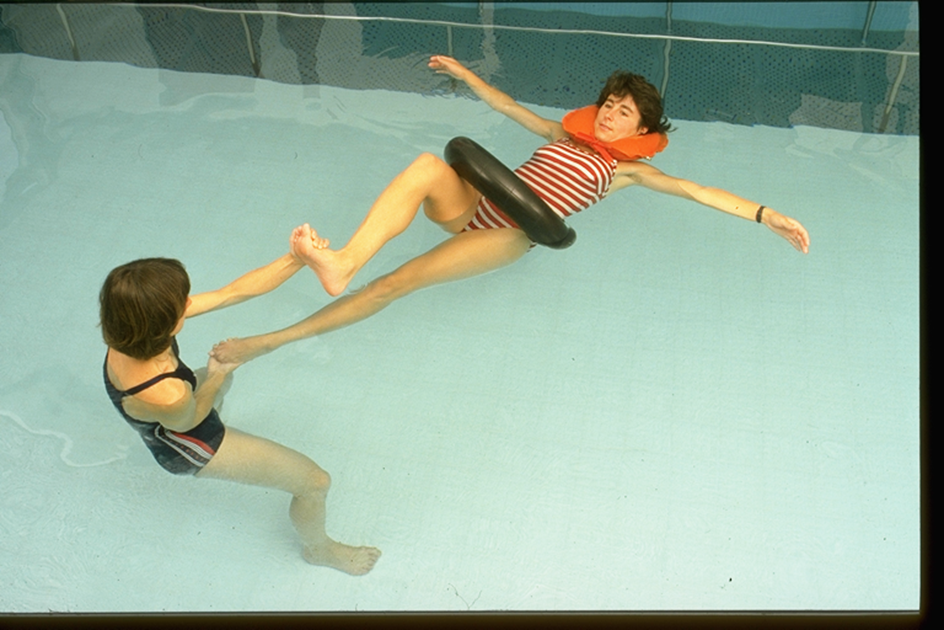
I will describe the photo and start with a quote from Beatrice Egger: “The technique demands high skill and accuracy of the therapist. So, the exact knowledge of the concept and a refined gripping technique are compulsory for the success of the Bad Ragaz Ring
Method”. I will relate this to my first point: EMG research.
The photo shows the end-position of the bilateral asymmetrical reciprocal pattern flexion-adduction-external rotation of the right isotonic leg and extension-adduction-external rotation of the left isometric leg (leave the description of the knees and joints of the feet).
The isometric activity of the left legs serves to stabilize the body especially in the end-position because the right leg is partly above water and will make the body roll towards the right. Functional Kinetics predicts that adduction activity in the left leg will stabilize external rotation of the right leg and external rotation activity of the left leg will stabilize adduction of the right leg (this is not a mistake in writing, JL). Therapist’s hand should guide – according to PNF principles – the proper chain, preventing the body to roll. Rolling means loss of balance and equilibrium reactions will interfere with the precise pattern. The precise pattern is important to activate the proper muscle (fibers) within the myofascial chain, according to the laws of segmental innervation.
The client in the photo could have been in supine with arms next to the body: gripping technique of Beatrice Egger is excellent.
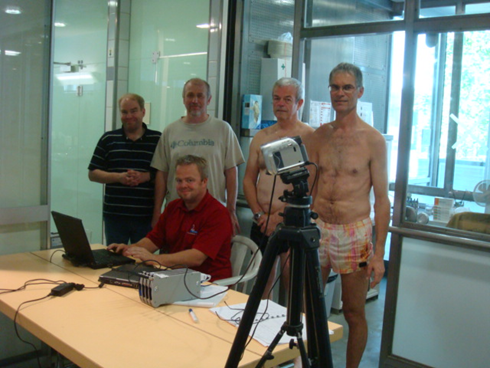
One important aspect cannot be shown in a photo, which is the approximation of the left isometric leg. In 2008, used EMG to evaluate various leg patterns and found that approximation activated both external obliques and erector spinae, whereas they remained silent when approximation was not used.
I will end with a clinical consideration. The client has 5 goals:
- Stepping into a bus (high step)
- Walking at least 500 feet over a market without the left knee giving way
- Crossing a street quickly
- Being able to reactively use a stumble-strategy
- Standing and weight-shifting in front of the workplace in the kitchen for 10 minutes
All examples include muscular activity, but for which of them would BRRM be an appropriate priming possibility?
What the research says (editor’s note)
- Stroke. In a randomized trial of 22 people with chronic stroke, adding the Bad Ragaz Ring Method to rehabilitation (3 days a week for 6 weeks) improved lower-leg muscle activation and balance more than rehabilitation alone.1
- Low back pain. In a 4-week pilot of community aquatic physiotherapy (44 adults with chronic low back pain), the BRRM group improved disability and trunk endurance and reported less pain. There was no land or no-treatment control group.2
- Knee osteoarthritis. In an observational study of 60 people with knee osteoarthritis treated in hot spring water, those who also received BRRM improved their WOMAC scores more. Patients were not randomized.3
The trials are small, and only one is randomized. The technique descriptions in this post are Johan Lambeck’s clinical teaching [Expert opinion].
Next in this series: Part 2, matching BRRM patterns to functional goals.
Frequently asked questions
Where did the Bad Ragaz Ring Method begin?
At the Werneheim orthopedic clinic in Wildbad, Germany, in the 1950s (Lambeck, 2025).
When was the ring method introduced in Bad Ragaz?
In 1957, at the Medical Center Bad Ragaz in Switzerland (Lambeck, 2025).
References
Research cited in this post
- Cha HG, Shin YJ, Kim MK. Effects of the Bad Ragaz Ring Method on muscle activation of the lower limbs and balance ability in chronic stroke: A randomised controlled trial. Hong Kong Physiother J. 2017;37:39-45. doi:10.1016/j.hkpj.2017.02.001. PubMed: 30931045.
- So BCL, Ng JK, Au KCK. A 4-week community aquatic physiotherapy program with Ai Chi or Bad Ragaz Ring Method improves disability and trunk muscle endurance in adults with chronic low back pain: A pilot study. J Back Musculoskelet Rehabil. 2019;32(5):755-767. doi:10.3233/BMR-171059. PubMed: 30689551.
- Wang J, Chen Z, Chen X, Yang Y, Gan W, Wang F. Impact of Bad Ragaz ring in hot spring water on knee osteoarthritis: A prospective observational study. Medicine (Baltimore). 2023;102(32):e34457. doi:10.1097/MD.0000000000034457. PubMed: 37565912.
How to cite this article
First published February 17, 2025 on atuseminars.com · Last updated October 19, 2026 · Permanent URL: https://www.aquatictherapyuniversity.com/blog/the-bad-ragaz-ring-method-brrm
How to cite
Lambeck, J. (2025, February 17). The Bad Ragaz Ring Method (BRRM). From the Deep End. https://www.aquatictherapyuniversity.com/blog/the-bad-ragaz-ring-method-brrm
Permissions: You may quote and cite this article with attribution. Reproducing or adapting the full article requires written permission from the author, Johan Lambeck. To request permission, write to info@swimatu.com and we will pass your request along.
Copyright: © 2025 Johan Lambeck. Submitted by the author for publication by ATU Educational Services, LLC.
For education only; not a substitute for individual clinical judgment.