
From The Deep End · ATU Blog
Starting a Movement: Aquatic Yoga
How Cynthia Bialek built Yoga Afloat, and the water temperatures and pool depths an aquatic yoga class needs.
First published January 29, 2024 on atuseminars.comYoga Afloat started with one person who wanted to keep practicing yoga while living with fibromyalgia, and needed somewhere her body could tolerate it. The pool was that place.
This short post looks at how Cynthia Bialek adapted yoga to the water, and what your pool needs to run a class.
Want to go deeper? Explore the 12 Ways to Progress Any Aquatic Exercise course →
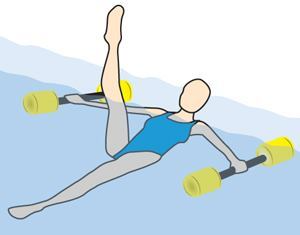
Cynthia Bialek has worked for years translating yoga into an aquatic environment. The resulting technique, known as Yoga Afloat, evolved out of her personal desire to continue the practice of yoga in a place that was comfortable and conducive for someone with acute fibromyalgia.
Bialek understood that it would not be possible to just transpose moves into the water without understanding the unique properties and principles of the water.
Read original article here, or continue reading below.
Water temperatures necessary for Yoga Afloat vary. Beginners, who need to move more slowly and deliberately to understand and perform the movements correctly, should have water that’s 86 to 88 degrees. For those who can move a bit quicker, and for the Yoga Afloat Power Moves Vinyasa, water can be as cold as 81 to 85 degrees.
For the suspended and floating poses, it’s best to have at least an 8-foot-deep pool, though it is possible to work in depths as shallow as 6 feet just by adjusting the moves a bit. Ideally, a participant should have a 6-foot working area in which to fully extend the body when floating. It’s more relaxing to have no loud noises around the pool during a Yoga Afloat class, but ... Continue Reading Article Here.
What the research says
- Aquatic yoga itself. We found no published trials of aquatic yoga in PubMed. The guidance in this post is the instructor’s clinical experience [Expert opinion].
- The condition it started with. A Cochrane review of 16 trials (881 participants) found low- to moderate-quality evidence that supervised aquatic exercise improves wellness, symptoms and fitness in adults with fibromyalgia.1 A 2024 review of four newer trials found positive results for pain and quality of life, but the benefits may be similar to other kinds of exercise.2
Frequently asked questions
What water temperature suits beginners in aquatic yoga?
Warm water, 86 to 88 degrees Fahrenheit, because beginners move slowly and deliberately while learning the poses (Aquatic Therapy University, 2024).
How deep should the pool be for floating yoga poses?
Ideally 8 feet or more; with some adjustments to the moves, 6 feet can work (Aquatic Therapy University, 2024).
What is Yoga Afloat?
An aquatic yoga method created by Cynthia Bialek, who wanted a comfortable setting for yoga for someone with acute fibromyalgia (Aquatic Therapy University, 2024).
References
Research cited in this post
- Systematic review and meta-analysisBidonde J, Busch AJ, Webber SC, et al. Aquatic exercise training for fibromyalgia. Cochrane Database Syst Rev. 2014;2014(10):CD011336. doi:10.1002/14651858.CD011336. PubMed: 25350761.
- ReviewRodríguez-Huguet M, Ayala-Martínez C, Góngora-Rodríguez P, Rosety-Rodríguez MÁ, Martín-Valero R, Góngora-Rodríguez J. Aquatic Exercise in Physical Therapy Treatment for Fibromyalgia: Systematic Review. Healthcare (Basel). 2024;12(6):701. doi:10.3390/healthcare12060701. PubMed: 38540665.
How to cite this article
First published January 29, 2024 on atuseminars.com · Last updated October 19, 2026 · Permanent URL: https://www.aquatictherapyuniversity.com/blog/starting-a-movement-aquatic-yoga
How to cite
Aquatic Therapy University. (2024, January 29). Starting a Movement: Aquatic Yoga. Aquatic Therapy University Blog. ATU Educational Services, LLC. https://www.aquatictherapyuniversity.com/blog/starting-a-movement-aquatic-yoga
Permissions: You may quote and cite this article with attribution. Reproducing or adapting the full article requires written permission from ATU Educational Services, LLC.
For education only; not a substitute for individual clinical judgment.