
From the Deep End · ATU Blog
Integration of Halliwick Principles into WST: Combining Elements of the Halliwick Ten-Point-Programme with WST to Enhance Postural Control and Functional Activities in Aquatic Therapy
How James McMillan's Halliwick pretraining grew into Water Specific Therapy, and how WST uses buoyancy, drag and waves to build skills for life on land.
First published January 29, 2025 on atuseminars.com Guest editorial. © 2025 Johan Lambeck. Submitted by the author for publication by ATU Educational Services, LLC.Johan Lambeck learned Halliwick from James McMillan and co-taught some 30 courses with him between 1982 and 1994. In this guest post he explains how McMillan's ideas became Water Specific Therapy, and how WST can be aimed at function on land.
Want to go deeper? Explore the Aquatic Therapy Essentials (Bootcamp) bundle →
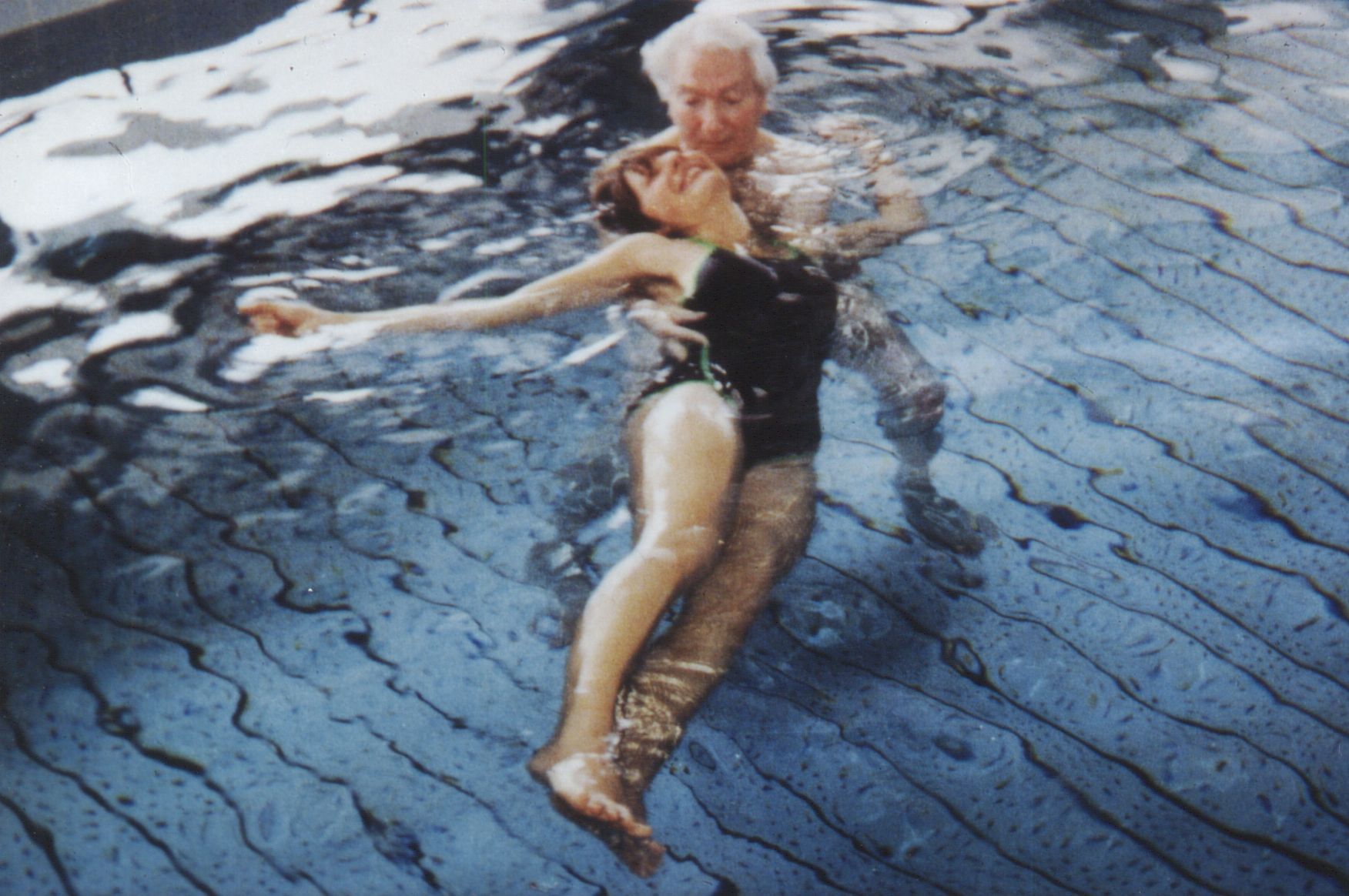
I had the pleasure to learn Halliwick from James McMillan. I learned, organized courses and later also was allowed to co-teach with him during some 30 courses in Netherlands and Switzerland between 1982 and 1994.
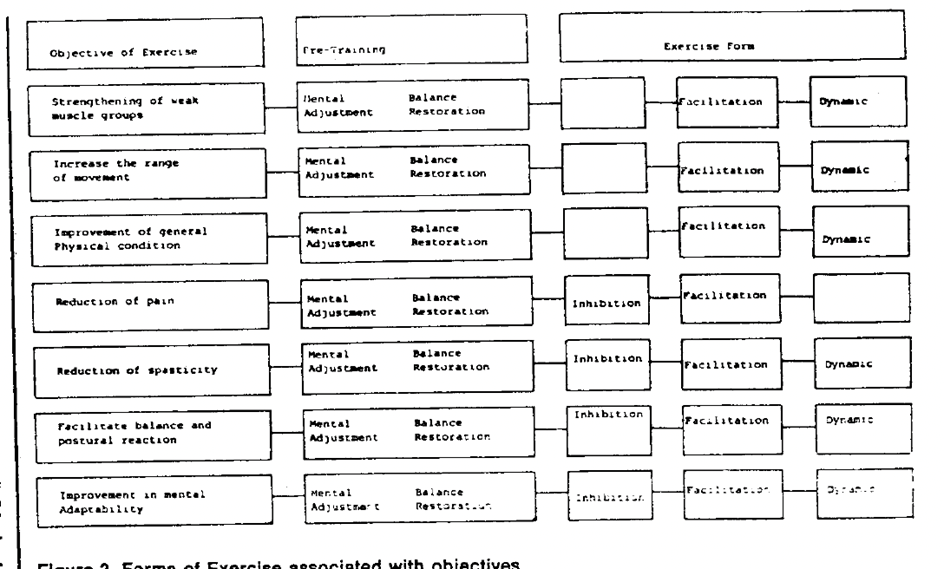
After 2 regular Halliwick courses, participants wanted to continue learning from him and he suggested to organize a course on “The logic of approach to exercise in water”. The basis was a decision tree (Mac mentioned the word algorithm). Elements in this tree were e.g. choice of water depth, form of exercise (inhibition, facilitation, dynamic), objective of the exercise, see below.
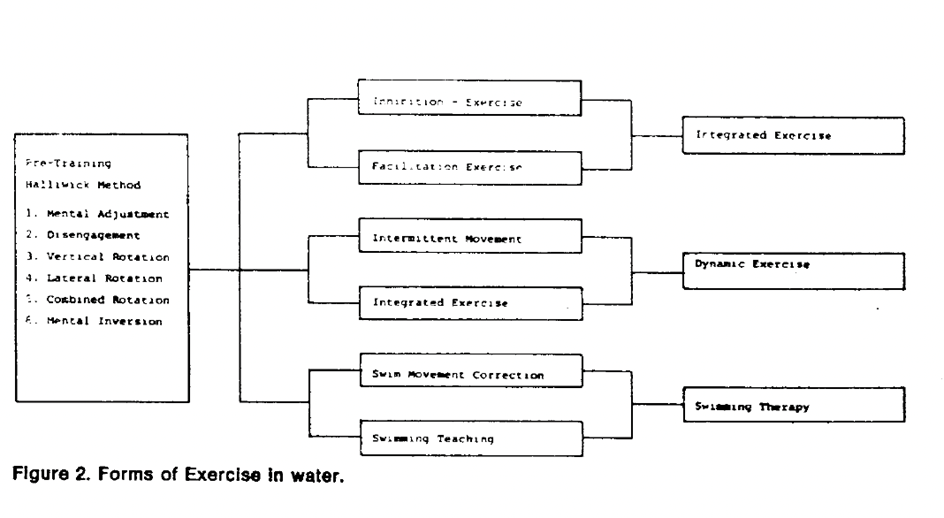
This figure comes from “The role of Water in Rehabilitation. Fysioterapeuten 1977; 45: 43-46, 87-90, 236-240” by McMillan (his only publication as a single author).
One can see in this schedule that he regarded Halliwick as pretraining, which can also read in the unpublished and undated manuscript below:
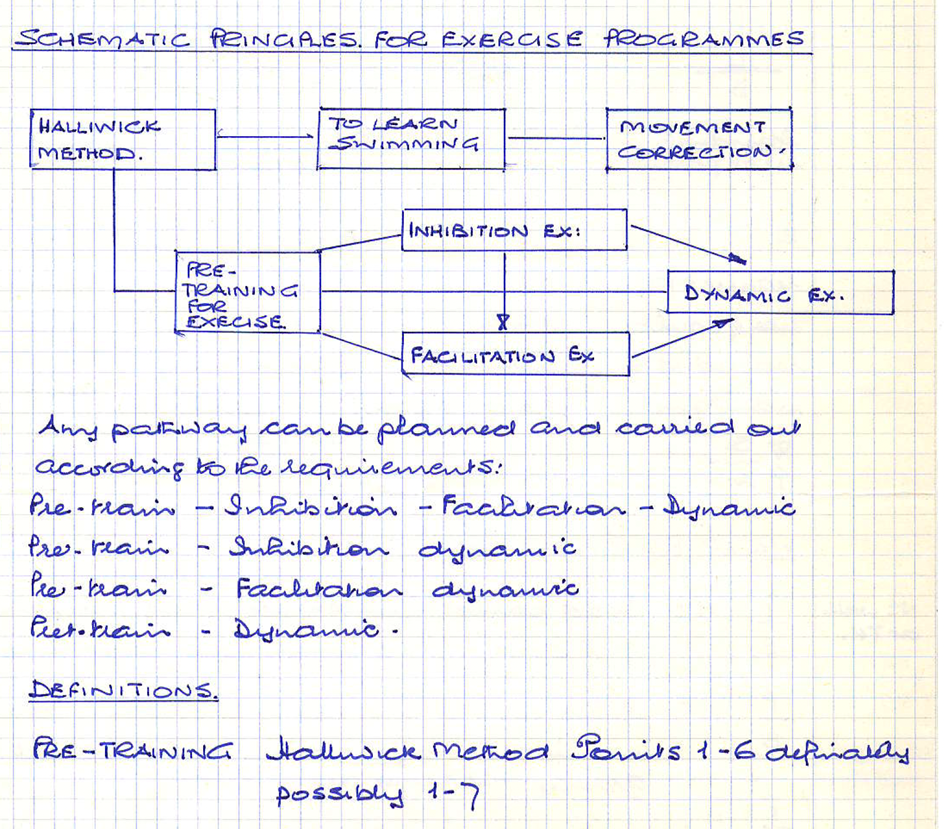
Pretraining basically means daring to fall and being able to stand up. This is necessary when dynamic exercise challenges balance (going to the limits of the basis of support, walking fast to train agility).
One of the points in pretraining is Transversal Rotation Control (TRC), which in itself can be a therapeutic exercise as well, e.g. to activate the ventral myofascial chain in an eccentric or concentric way. But TRC in the sense of pretraining is just about being able to stand up after a loss of balance in which quality of moment is not important, only quantity.
The figure underneath also shows the objectives of the exercise or treatment goals. Nowadays we classify the goals according to the International Classification of Functioning, Disability and Health (ICF).
McMillan changed wording from “The logic of approach to exercise in water” to “Water specific exercise”, which became ‘Water Specific Therapy”, as used by Urs Gamper in his German book Wasserspezifische Bewegungstherapie und Training” by (1995). Urs Gamper is a Swiss physical therapist who worked in the thermal center in Bad Ragaz (and later in the rehab center in the neighboring Valens). Gamper was appointed to McMillan, who was in charge of a group of therapists, developing herapy from the Halliwick swimming method. McMillan started teaching Halliwick courses in Bad Ragaz in 1963 and was asked to work there and head the group in 1974. This group lasted till 1979 when McMillan chose to travel the world to teach.
Water Specific Therapy (WST) is defined by Gamper as a therapeutically functional treatment, adapted to the biomechanics of the human body and based on the specific characteristics of water: the buoyancy-gravity relationship, flow conditions and waves.
The specific characteristics are:
- The buoyancy-gravity relationship: applied in the metacentric effect construct. Both forces are almost equal, but opposite and with their centers at different places. This makes it easy to create stabilizing or destabilizing torques by changing the relationship. Stabilizing torques are mostly seen as various postural reactions (righting, equilibrium etc)
- Flow conditions: in general, used as turbulent drag, not only providing resistance against active movement by the client, but also used to by the therapist’s hands to influence balance
- Waves can be transversal or longitudinal. In both cases containing (kinetic) energy influencing balance of a client, e.g. during agility training
These characteristics allow to easily create:
- situations in which patients work actively with their own changes of body shape and/or added torques in stabilizing or mobilizing ways
- reactive exercises (by – unexpected – perturbations)
- changes of the punctum fixum and punctum mobile
- all variations between closed – and open kinetic chains
- movements with a very low level of force or power
- high torques on the trunk without additional weights (as on land)
Halliwick originally was meant to be motor learning in water to be used in water (swimming). Possible effects on land, like increased head control, were not the primary goals.
WST can be regarded as motor learning in water to be used on land on purpose (see the figures): based on clinical reasoning, evidence based clinical practice, ICF in contemporary topics in neuromusculoskeletal therapy.
Neuromusculoskeletal pediatrics still is mostly CP
You might choose which CP. Perhaps my AquaClinica example GFMCS V and/or perhaps ‘Cristina” in GFMCS III
Quickly going through EBM (external literature) and reasoning towards WST, using the characteristics in FITT principles
· I would focus on verticalization: being restrictive with prone/supine. If supine: then as a way to force the trunk to be used like in constraint induced movement therapy
What the research says (editor’s note)
This guest post describes Johan Lambeck’s clinical teaching [Expert opinion]. Here is where the published evidence on Halliwick stands:
- Cerebral palsy. A systematic review found five studies of Halliwick-based therapy in children with CP. Four showed better gross motor function and aquatic skills, but the studies were of limited quality.1
- Water vs land. A 2025 meta-analysis of 15 trials in children with CP found low-quality evidence that aquatic exercise is comparable to land exercise. Aquatic physical therapy had a small edge on gross motor function, but Halliwick alone showed no significant difference.2
- How it is delivered. A scoping review of 24 Halliwick studies found no agreement on how sessions should be structured, and 14 studies had no control group.3
So the method is widely used and promising, but it still needs larger, controlled trials with clear session plans.
Frequently asked questions
What does pretraining mean in the Halliwick Concept?
Being willing to lose balance and able to get back to standing, which is needed before dynamic balance work (Lambeck, 2025).
What is Water Specific Therapy (WST)?
As described by Urs Gamper, WST is functional therapy built on the water's buoyancy-gravity relationship, flow and waves, aiming for motor learning that carries over to land (Lambeck, 2025).
What is Transversal Rotation Control (TRC)?
TRC is one of the Halliwick pretraining points; it can also be used as a therapeutic exercise, for example to activate the ventral myofascial chain (Lambeck, 2025).
References
Research cited in this post
- Systematic reviewTapia C, Constanzo J, González V, Barría RM. The Effectiveness of Aquatic Therapy Based on the Halliwick Concept in Children with Cerebral Palsy: A Systematic Review. Dev Neurorehabil. 2023;26(6-7):371-376. doi:10.1080/17518423.2023.2259986. PubMed: 37728374.
- Systematic review and meta-analysisPauluka E, Ceolin LS, Fontanela LC, Dos Santos AN. Aquatic Compared With Land-Based Exercises on Gross Motor Function of Children/Adolescents With Cerebral Palsy: A Systematic Review With Meta-Analysis. Child Care Health Dev. 2025;51(1):e70023. doi:10.1111/cch.70023. PubMed: 39688349.
- Rohn S, Novak Pavlic M, Rosenbaum P. Exploring the use of Halliwick aquatic therapy in the rehabilitation of children with disabilities: A scoping review. Child Care Health Dev. 2021;47(6):733-743. doi:10.1111/cch.12887. PubMed: 34155683.
How to cite this article
First published January 29, 2025 on atuseminars.com · Last updated October 19, 2026 · Permanent URL: https://www.aquatictherapyuniversity.com/blog/integration-of-halliwick-principles-into-wst-combining
How to cite
Lambeck, J. (2025, January 29). Integration of Halliwick Principles into WST: Combining Elements of the Halliwick Ten-Point-Programme with WST to Enhance Postural Control and Functional Activities in Aquatic Therapy. From the Deep End. https://www.aquatictherapyuniversity.com/blog/integration-of-halliwick-principles-into-wst-combining
Permissions: You may quote and cite this article with attribution. Reproducing or adapting the full article requires written permission from the author, Johan Lambeck. To request permission, write to info@swimatu.com and we will pass your request along.
Copyright: © 2025 Johan Lambeck. Submitted by the author for publication by ATU Educational Services, LLC.
For education only; not a substitute for individual clinical judgment.