
From The Deep End · ATU Blog
Heart Warming: Aquatic Cardiac Therapy
Why upright water exercise is now seen as a safer choice than swimming for many heart and lung patients, plus the water temperature, depth and training methods to use.
First published December 18, 2023 on atuseminars.comFor years, many patients with heart failure, circulatory problems or lung disease were told to stay out of the pool. Yet very few researchers looked at what upright water exercise could do for them.
In this post I explain what we have learned since, and what water temperature, depth and training methods you need to run cardiopulmonary training in your pool.
Want to go deeper? Explore the Introduction to Aquatic Therapy: Cardiopulmonary Compromise course →
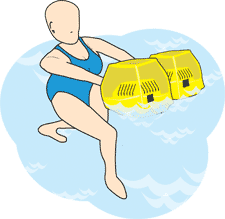
Turns out a heated pool is great place for cardio therapy and rehab. Is your facility right for this growing population?
But strangely, during the same time period, very few investigators examined the benefits of any vertical aquatic exercise for the cardiac or respiratory patient.
In fact, many patients with congestive heart failure, circulatory insufficiencies, or respiratory disease often were warned vehemently against exercising in the pool.
Over the past 20 years, however, it has been shown repeatedly that vertical aquatic exercise does not offer the same risks to the cardiopulmonary compromised patient as swimming does. In effect, the pool just became vogue for this growing population.
Continue reading below.
The concept of vertical exercise in the pool (originally called hydro-gymnastics) gained accelerated exposure in the early 1900s. By the 1950s and 1960s, the age of space exploration did much to stimulate research into the effects of “reduced gravity environments” on breathing and circulation. But it wasn’t until the 1990s that a new organization, the Aquatic Exercise Association, and the Aquatic Section of the American Physical Therapy Association, brought the same popularity to vertical aquatic exercise as horizontal swimming had enjoyed.
To provide efficient cardiopulmonary training in your pool, you will need water temperature no greater than — and preferably less than — 93 degrees Fahrenheit.
Most therapy pools hold their temperatures between 90 and 94 degrees. However, because cardiopulmonary training can elevate the body’s core temperature, cooler waters will allow for more intensive training.
Reading Original Article Here or keep reading below.
Traditional swimming pools, with temperatures near 80 degrees, can be used for very vigorous aerobic training. Otherwise, pools ranging between 85 and 90 degrees make excellent sites for cardiopulmonary workouts. Humidity levels exceeding 50 percent will make it more difficult for patients to disperse heat during workouts.
A pool with a sloping bottom running between 3-feet and 4-feet deep will work just fine, unless deep-water work is desired. Cardiopulmonary training can be performed in almost any position — or depth — in the pool. There is no single exercise that defines this kind of training.
Some of the more popular training methods include
1 Breath-control while swimming beneath the surface. This should be done only with careful supervision.
2 Forceful exhalation of air through tubing or large straws into progressively deeper water.
3 Propulsion of an object across the pool’s surface using sustained breaths. The object can be as low-tech as a ping pong ball or as elaborate as an Egg-Flip, a toy that flips on its axis when bombarded with air.
4 Circuit training, consisting of brief bursts of strength-training “stations” interspersed with aerobic exercise.
5 Calisthenics performed in waist- or chest-deep water.
6 Water walking in waist- or chest-deep water.
7 “Charging the hill,” in which participants stride from chest-deep water to thigh-deep water and back again.
8 Deep-water running using a noodle or buoyancy belt.
9 Lap swimming, recommended for the skilled swimmer only.
At a minimum, your facility will need to stock water noodles, flotation belts and resistive equipment such as barbells, paddles or gloves. Well-equipped pools also stock tubing, straws, Egg-Flips or ping-pong balls, dive toys and heart rate monitors.
Few commercial seminars are available today to address only cardiopulmonary training; however, many aquatic therapy seminars include cardiac training as part of the package.
Fortunately, there are hundreds of training DVDs that explore aerobic exercise in the pool. Many of these exercises can be extrapolated for use in your pool by a competent therapist.
Some helpful references
Jug, B., Vasić, D., Novaković, M., Avbelj, V., Rupert, L., & Kšela, J. (2022). The effect of aquatic exercise training on heart rate variability in patients with coronary artery disease. Journal of Cardiovascular Development and Disease, 9(8), 251.
Cugusi, L., Manca, A., Bassareo, P. P., Crisafulli, A., Deriu, F., & Mercuro, G. (2020). Supervised aquatic-based exercise for men with coronary artery disease: a meta-analysis of randomised controlled trials. European Journal of Preventive Cardiology, 27(19), 2387-2392.
Monoli, C., Tuhtan, J. A., Piccinini, L., & Galli, M. (2023). Wearable technologies for monitoring aquatic exercises: A systematic review. Clinical Rehabilitation, 37(6), 791-807.
Benzo-Iglesias, M. J., Rocamora-Pérez, P., Valverde-Martínez, M. Á., García-Luengo, A. V., & López-Liria, R. (2023). Effectiveness of Water-Based Exercise in Patients with Chronic Obstructive Pulmonary Disease: Systematic Review and Meta-Analysis. Sensors, 23(20), 8557.
Frequently asked questions
Is vertical aquatic exercise risky for cardiopulmonary-compromised patients?
Not in the way swimming can be. Over the last 20 years, upright water exercise has repeatedly been found less risky than swimming for these patients (Salzman, 2023).
Why does cooler water allow more intensive cardiopulmonary training?
Cardiopulmonary training raises core body temperature, so cooler water lets patients train harder before they overheat (Salzman, 2023).
Can an 80-degree swimming pool be used for aerobic training?
Yes. A traditional pool kept near 80 degrees Fahrenheit is suitable for very vigorous aerobic work (Salzman, 2023).
How to cite this article
First published December 18, 2023 on atuseminars.com · Last updated October 19, 2026 · Permanent URL: https://www.aquatictherapyuniversity.com/blog/heart-warming-aquatic-cardiac-therapy
How to cite
Salzman, A. (2023, December 18). Heart Warming: Aquatic Cardiac Therapy. Aquatic Therapy University Blog. ATU Educational Services, LLC. https://www.aquatictherapyuniversity.com/blog/heart-warming-aquatic-cardiac-therapy
Permissions: You may quote and cite this article with attribution. Reproducing or adapting the full article requires written permission from ATU Educational Services, LLC.
For education only; not a substitute for individual clinical judgment.