
From The Deep End · ATU Blog
Back in the Game: Aquatic Spinal Stabilization
Why buoyancy makes core and spinal stabilization training easier to start for people with back pain, and why almost any pool will do.
First published December 27, 2023 on atuseminars.comSpinal stabilization is trainable, but for many patients with back pain, a mat on land is an uncomfortable place to start. This post explains why the pool is a natural fit for core work, and why you don't need a special therapy pool to do it.
Want to go deeper? Explore the Innovative Aquatic Therapy for Low Back & Neck Dysfunction course →
Late-night television is inundated with products designed to bring buff abdominals to the flabby masses. A potpourri of silly contraptions, including I kid you not what looks like a miniaturized La-Z-Boy recliner, are sold for three easy payments of $29.95 each to the eternally hopeful.
Therapists concur with late-night hosts on one point, at least: The ability to stabilize the pelvis and spine is trainable. It's just hard.
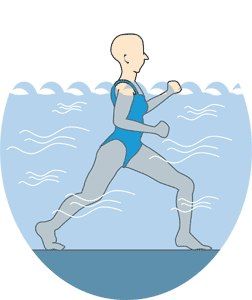
And for patients with back pain, land-based spinal stabilization can be too uncomfortable. On land, gravity rules: compressing spinal disks, loading joints and reinforcing muscular tension. In the water, buoyancy combats gravity and the spine wins.
Full article link or continue reading below.
Spinal stabilization is a natural fit in water. It is possible to make a task easier (assisted by buoyancy) and more challenging (resisted by buoyancy or drag) in the water. It's much easier for patients to achieve pain-free training in the pool than on a mat.
Additionally, to provide efficient spinal stabilization training in the water, you do not need a specialized therapy pool. Almost any water temperature and depth will do in a pinch.
Unlike cardiac conditioning, which often requires cooler waters for heat dispersion, or Watsu, which is best performed in water warmer than 93 degrees Fahrenheit, core muscle strengthening ... Continue Reading Article Here.
Frequently asked questions
Can water make spinal stabilization tasks easier or harder?
Both. Floating support can help a movement along, and the water's buoyancy or drag can also be set up to resist it (Salzman, 2023).
Do you need a specialized therapy pool for aquatic spinal stabilization?
No. Efficient spinal stabilization training can be done in an ordinary pool (Salzman, 2023).
What water temperature and depth work for core stabilization?
Nearly any temperature or depth works in a pinch, unlike cardiac conditioning or Watsu, which need cooler or warmer water (Salzman, 2023).
References
- Palladino, L., Ruotolo, I., Berardi, A., Carlizza, A., & Galeoto, G. (2023). Efficacy of aquatic therapy in people with spinal cord injury: a systematic review and meta-analysis. Spinal Cord, 61(6), 317-322.
- Corvillo, I., Armijo, F., Álvarez-Badillo, A., Armijo, O., Varela, E., & Maraver, F. (2020). Efficacy of aquatic therapy for neck pain: a systematic review. International journal of biometeorology, 64, 915-925.
- Selph, S. S., Skelly, A. C., Wasson, N., Dettori, J. R., Brodt, E. D., Ensrud, E., ... & McDonagh, M. (2021). Physical activity and the health of wheelchair users: a systematic review in multiple sclerosis, cerebral palsy, and spinal cord injury. Archives of physical medicine and rehabilitation, 102(12), 2464-2481.
How to cite this article
First published December 27, 2023 on atuseminars.com · Last updated October 19, 2026 · Permanent URL: https://www.aquatictherapyuniversity.com/blog/back-in-the-game-aquatic-spinal-stabilization
How to cite
Salzman, A. (2023, December 27). Back in the Game: Aquatic Spinal Stabilization. Aquatic Therapy University Blog. ATU Educational Services, LLC. https://www.aquatictherapyuniversity.com/blog/back-in-the-game-aquatic-spinal-stabilization
Permissions: You may quote and cite this article with attribution. Reproducing or adapting the full article requires written permission from ATU Educational Services, LLC.
For education only; not a substitute for individual clinical judgment.