
From The Deep End · ATU Blog
Part 1 of 2Five most common aquatic therapy myths for cardiopulmonary patients (Part 1 of 2)
Part 1: what immersion really does to the heart and lungs, why swimming studies gave the pool a bad name, and who can and cannot exercise in water.
First published August 7, 2024 on atuseminars.comAsk a cardiologist whether a heart patient can use the pool, and you may get a quick no. That no usually traces back to studies of swimming.
Standing in water is not swimming. In Part 1, we explain what immersion does to the heart and lungs, then tackle the first of five myths.
Want to go deeper? Explore the Introduction to Aquatic Therapy: Cardiopulmonary Compromise course →
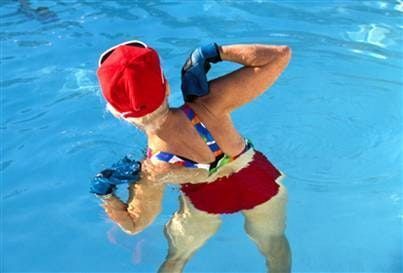
It may not be a question for the ages, but it is an important question to ask. Is aquatic exercise safe for my patient with COPD, CHF, MI or other cardiopulmonary disorders?
There are 5 prevalent myths that have edged into the collective medical psyche and which must be tackled in order to suss out the truth. In order to do so, it is important to first understand what happens when a person stands immersed in water, before placing a single limb in motion.
So, What Happens to the Heart & Lungs During Immersion?
During immersion, the water’s pressure pushes inwardly and — at any given depth -- equally on the body.
So if we stand at rest with our legs immersed in 3’ of water, both knees will experience an equal amount of circumferential pressure pushing into the joint. And while the pressure is equal at any given depth, it increases as the depth increases. This phenomenon helps explain why vertical immersion (standing upright) produces such a different hemodynamic response from horizontal immersion (floating or swimming). Let’s explore what happens, step by step, from the moment we step into the water.
First, we experience an external pressure from the water; this pressure is known as hydrostatic pressure. How strong is this pressure? Well, it depends on the depth. During immersion in 100 cm of water (about 3.3’ of water), the water exerts an external pressure of 76 mm of mercury. If we go deeper (say 5’), the pressure at our feet becomes even greater, reaching > 100 mm of mercury. Compare this with the much lower pressures (40-60 mm) we would experience during surface swimming.1,2
Second, this “hydrostatic pressure” compresses the venous and lymphatic vessels in our legs inward. End result? A large shift in blood and lymph from our legs to our abdomen and (if we are immersed deep enough) to our thorax. If we are immersed all the way to the neck, the increase in central volume is quite substantial (around 700 ml). Three cups may not sound like much, but it represents a 60% increase in central volume. In contrast, during swimming, there is no pressure differential, so blood is not “assisted” back up to our heart.1,2
Third, around 1/4 of this increased thoracic volume ends up in the chambers of our heart. My left ventricular preload increases by 40-70 ml, and — per Starling’s Law — this stretch of muscle fibers results in a more powerful contraction. My left ventricle ejects 35-45% greater stroke volume every time it pumps out blood, meaning that cardiac output increases by around 1500 ml/minute during clavicle level immersion. In fact, vertical immersion in water up to our neck produces a similar stroke volume to that of a deconditioned subject exercising to max capacity on land.1,2 This effect is age dependent — older patients show a smaller increase in volume, temperature dependent — the warmer the water, the greater the volume increase, and disease-specific —patients with severe CHF may not show this increase in stroke volume.1
Fourth, a portion of the displaced volume of blood ends up in the large vessels of our lungs.1,2 More on this later.
Fifth, our brain recognizes this large change in central volume and – via the sympathetic nervous system – decreases the vasoconstriction of our blood vessels. This reduces both peripheral vascular tone and systemic vascular resistance by 30% (at thermoneutral temperatures). According to Becker, this drop is long lasting – starting during the first hour of immersion and persevering for a period of hours thereafter. This vasodilation of the peripheral system decreases end-diastolic pressures in the heart.1
So, with this background information in mind, let’s examine the 5 myths that often prevent medical professionals from prescribing aquatic exercise.
Myth #1. Aquatic exercise has been shown to produce dangerous stressors on the cardiac system and should not be prescribed for the cardiac compromised client.
Several generations of cardiologists have made an understandable — yet consequential — error in prescribing pool exercise to their compromised patients. What is this profound error? They have treated swimming and vertical aquatic exercise as identical twins. Swimming and vertical water exercise are not created equal and should never be treated the same when prescribing exercise for the cardiopulmonary compromised client. So how did this misconception come to pass?
Chalk it up to the staying power of partial information. There was a handful of well-reported scientific studies done in the 1970s and 80s, all examining the safety of exercise for the cardiac patient.3–5 Ground-breaking stuff, really.
These papers, by and large, were trying to answer the question “Swimming: yes or no?” for the post-infarction patient with left ventricular dysfunction. Their collective findings showed that swimming — even swimming at a relatively glacial pace — resulted in an increase in cardiovascular and hormonal stress.2
Of special note was the fact that swimming could result in VO2 of 54-87% of max, even for qualified swimmers.2 The weakish swimmer? Mama, call the EMT.
Those poor souls were hitting 90%+ of max VO2. Take home message: Swimming can be dangerous for the cardiac patient, especially the cardiac patient who looks more akin to Lucille Ball than Michael Phelps when taking the proverbial lap.
Because of these highly publicized studies, a generation of physicians made the swimming pool verboten for all cardiac patients. What they meant to do was spread the message that post-MI and CHF patient should stay away from swimming, a semi-valid conclusion. What they ended up doing is telling them is to stay away from the pool. Big diff.
So, what should we be telling our cardiac compromised patients about immersion? Here are the facts as we know them, based not on rumor or misinterpreted studies, but on the latest published evidence.
Swimming and vertical aquatic exercise produce completely different hemodynamic effects on the body. Patients with cardiac histories, especially those who are not strong swimmers, should not participate in swimming without clearance from their physician.2–5 In contrast, vertical exercise is safe for a large percentage of cardiac patients (for the exceptions, read on).
There is a big difference (hemodynamically speaking) between immersion to the chest and immersion to the neck. Immersion to the neck can produce abnormal hemodynamic responses temporarily in cardiac patients.2 Although present, these may not be of clinical significance.2
Decompensated heart failure is an absolute contraindication for water therapy. Patients with severe heart failure (NYHA IV) should not participate in immersion.2
Caution is “prudent” when working with individuals with severe valvular insufficiency, because cardiac enlargement may mechanically worsen this problem during full immersion.1
Subjective impressions are no guarantee that the left ventricle is tolerating the increased volume caused by immersion. Clinicians should not solely rely on the patient’s report that he is “feeling good” when assessing safety.2
Therapeutic water exercises in a pool can be allowed for patients with Q-wave myocardial infarctions older than 6 weeks, and/or mild and moderate CHF, provided that patients are in an upright position and immersed no deeper than the xiphoid process.2
Studies indicate that immersion may be a very useful tool in rehabilitation of the patient with mild to moderate CHF.1 Small Japanese studies of repeated thermal therapy (warm-water bathing or sauna) in heart failure reported better heart function and well-being,6 and a 2008 review attributes the benefit of warm-water bathing to lower afterload as the blood vessels relax.2 Exercise trials point the same way: in stable heart failure, aquatic training improved walking distance and peak power about as much as land training.7
Immersion in water temperatures ranging from 31-38° Celsius (87.8-100.4° Fahrenheit) are generally considered safe for both the normotensive and hypertensive patient.1
Now that we understand the effects of immersion and exercise on the cardiac patient, let’s turn our attention to the individual with pulmonary compromise.
Continued in Part 2. Read Part 2.
What newer research says
- Heart failure, 2015 meta-analysis. 8 studies (156 people with stable heart failure): aquatic training improved 6-minute walk distance and peak power compared with usual care, similar to land training.7
- Coronary artery disease, 2023 meta-analysis. 8 trials: water-based exercise raised peak VO2 by about 3.4 mL/kg/min compared with no exercise.8
These trials enrolled stable patients exercising upright, mostly in chest-deep water; they do not cover swimming or decompensated heart failure.
Frequently asked questions
What happens to the heart and lungs during immersion?
Water pressure squeezes blood from the legs toward the chest, so more blood fills the heart and some moves into the large vessels of the lungs (Aquatic Therapy University, 2024).
How does water pressure act on the body during immersion?
It presses inward on the body, equally on all surfaces at the same depth (Aquatic Therapy University, 2024).
Does water pressure increase with depth?
Yes. The pressure is the same at any one depth but increases as you go deeper (Aquatic Therapy University, 2024).
References
References
- ReviewBecker BE. Aquatic therapy: scientific foundations and clinical rehabilitation applications. PM R. 2009;1(9):859-72. doi:10.1016/j.pmrj.2009.05.017. PubMed: 19769921.
- ReviewMeyer K, Leblanc MC. Aquatic therapies in patients with compromised left ventricular function and heart failure. Clin Invest Med. 2008;31(2):E90-7. doi:10.25011/cim.v31i2.3369. PubMed: 18377766.
- Magder S, Linnarsson D, Gullstrand L. The effect of swimming on patients with ischemic heart disease. Circulation. 1981;63(5):979-86. doi:10.1161/01.cir.63.5.979. PubMed: 7471381.
- Heigenhauser GF, Boulet D, Miller B, Faulkner JA. Cardiac outputs of post-myocardial infarction patients during swimming and cyclic. Med Sci Sports. 1977;9(3):143-7. PubMed: 593075.
- McMurray RG, Fieselman CC, Avery KE, Sheps DS. Exercise hemodynamics in water and on land in patients with coronary artery disease. J Cardiopulm Rehabil. 1988;8(2):69-75. doi:10.1097/00008483-198802000-00004.
- Tei C, Tanaka N. Comprehensive therapy for congestive heart failure: a novel approach incorporating thermal vasodilation. Intern Med. 1996;35(1):67-9. doi:10.2169/internalmedicine.35.67. PubMed: 8652944.
Newer research
- Systematic review and meta-analysisAdsett JA, Mudge AM, Morris N, Kuys S, Paratz JD. Aquatic exercise training and stable heart failure: A systematic review and meta-analysis. Int J Cardiol. 2015;186:22-8. doi:10.1016/j.ijcard.2015.03.095. PubMed: 25804460.
- Systematic review and meta-analysisGuimarães ALA, Gomes-Neto M, Conceição LSR, Saquetto MB, Gois CO, Carvalho VO. Water-Based Exercises on Peak Oxygen Consumption, Exercise Time, and Muscle Strength in Patients with Coronary Artery Disease: A Systematic Review with Meta-Analysis. Cardiovasc Ther. 2023;2023:4305474. doi:10.1155/2023/4305474. PubMed: 37404774.
How to cite this article
First published August 7, 2024 on atuseminars.com · Last updated October 19, 2026 · Permanent URL: https://www.aquatictherapyuniversity.com/blog/five-most-common-aquatic-therapy-myths-for-cardiopulmonary-part-1
How to cite
Aquatic Therapy University. (2024, August 7). Five most common aquatic therapy myths for cardiopulmonary patients (Part 1 of 2). Aquatic Therapy University Blog. ATU Educational Services, LLC. https://www.aquatictherapyuniversity.com/blog/five-most-common-aquatic-therapy-myths-for-cardiopulmonary-part-1
Permissions: You may quote and cite this article with attribution. Reproducing or adapting the full article requires written permission from ATU Educational Services, LLC.
For education only; not a substitute for individual clinical judgment.